Refine search
Actions for selected content:
26077 results in Abstract analysis
LINEAR SERIES ON GENERAL CURVES WITH PRESCRIBED INCIDENCE CONDITIONS
- Part of
-
- Journal:
- Journal of the Institute of Mathematics of Jussieu / Volume 22 / Issue 6 / November 2023
- Published online by Cambridge University Press:
- 06 June 2022, pp. 2857-2877
- Print publication:
- November 2023
-
- Article
-
- You have access
- Open access
- HTML
- Export citation
-
Using degeneration and Schubert calculus, we consider the problem of computing the number of linear series of given degree d and dimension r on a general curve of genus g satisfying prescribed incidence conditions at n points. We determine these numbers completely for linear series of arbitrary dimension when d is sufficiently large, and for all d when either $r=1$ or $n=r+2$. Our formulas generalise and give new proofs of recent results of Tevelev and of Cela, Pandharipande and Schmitt.


Bouquets of curves in surfaces
- Part of
-
- Journal:
- Glasgow Mathematical Journal / Volume 65 / Issue 1 / January 2023
- Published online by Cambridge University Press:
- 06 June 2022, pp. 90-97
-
- Article
-
- You have access
- Open access
- HTML
- Export citation
Finite-time blow-up in a repulsive chemotaxis-consumption system
- Part of
-
- Journal:
- Proceedings of the Royal Society of Edinburgh. Section A: Mathematics / Volume 153 / Issue 4 / August 2023
- Published online by Cambridge University Press:
- 06 June 2022, pp. 1150-1166
- Print publication:
- August 2023
-
- Article
- Export citation
-
In a ball $\Omega \subset \mathbb {R}^{n}$
 with $n\ge 2$
 , the chemotaxis system\[ \left\{ \begin{array}{@{}l} u_t = \nabla \cdot \big( D(u)\nabla u\big) + \nabla\cdot \big(\dfrac{u}{v} \nabla v\big), \\ 0=\Delta v - uv \end{array} \right. \]is considered along with no-flux boundary conditions for $u$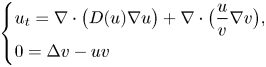
 and with prescribed constant positive Dirichlet boundary data for $v$
 . It is shown that if $D\in C^{3}([0,\infty ))$
 is such that $0< D(\xi ) \le {K_D} (\xi +1)^{-\alpha }$
 for all $\xi >0$
 with some ${K_D}>0$
 and $\alpha >0$
 , then for all initial data from a considerably large set of radial functions on $\Omega$
 , the corresponding initial-boundary value problem admits a solution blowing up in finite time.


The ground states of quasilinear Hénon equation with double weighted critical exponents
- Part of
-
- Journal:
- Proceedings of the Royal Society of Edinburgh. Section A: Mathematics / Volume 153 / Issue 3 / June 2023
- Published online by Cambridge University Press:
- 03 June 2022, pp. 1037-1044
- Print publication:
- June 2023
-
- Article
- Export citation
-
We prove the existence of nontrivial ground state solutions of the critical quasilinear Hénon equation $\displaystyle -\Delta _p u=|x|^{\alpha _1}|u|^{p^{*}(\alpha _1)-2}u-|x|^{\alpha _2}|u|^{p^{*}(\alpha _2)-2}u\ \ {\rm in}\ \mathbb {R}^{N}.$ It is a new problem in the sense that the signs of the coefficients of critical terms are opposite.
The fundamental gap of a kind of sub-elliptic operator
-
- Journal:
- Proceedings of the Royal Society of Edinburgh. Section A: Mathematics / Volume 153 / Issue 4 / August 2023
- Published online by Cambridge University Press:
- 03 June 2022, pp. 1118-1149
- Print publication:
- August 2023
-
- Article
- Export citation
ON THE TEMPERED FUNDAMENTAL GROUPS OF HYPERBOLIC CURVES OF GENUS $0$ OVER $\overline {\mathbb {Q}}_p$
- Part of
-
- Journal:
- Journal of the Institute of Mathematics of Jussieu / Volume 22 / Issue 6 / November 2023
- Published online by Cambridge University Press:
- 01 June 2022, pp. 2833-2856
- Print publication:
- November 2023
-
- Article
- Export citation
-
Let p be a prime number. In the present paper, we prove that the moduli of hyperbolic curves of genus $0$ over an algebraic closure of the field of p-adic numbers may be completely determined by their tempered fundamental groups.


PRM volume 152 issue 3 Cover and Back matter
-
- Journal:
- Proceedings of the Royal Society of Edinburgh. Section A: Mathematics / Volume 152 / Issue 3 / June 2022
- Published online by Cambridge University Press:
- 01 June 2022, pp. b1-b2
- Print publication:
- June 2022
-
- Article
-
- You have access
- Export citation
PRM volume 152 issue 3 Cover and Front matter
-
- Journal:
- Proceedings of the Royal Society of Edinburgh. Section A: Mathematics / Volume 152 / Issue 3 / June 2022
- Published online by Cambridge University Press:
- 01 June 2022, pp. f1-f2
- Print publication:
- June 2022
-
- Article
-
- You have access
- Export citation
Community detection and percolation of information in a geometric setting
- Part of
-
- Journal:
- Combinatorics, Probability and Computing / Volume 31 / Issue 6 / November 2022
- Published online by Cambridge University Press:
- 31 May 2022, pp. 1048-1069
-
- Article
-
- You have access
- Open access
- HTML
- Export citation
Steady states of thin-film equations with van der Waals force with mass constraint
- Part of
-
- Journal:
- European Journal of Applied Mathematics / Volume 34 / Issue 2 / April 2023
- Published online by Cambridge University Press:
- 30 May 2022, pp. 280-302
-
- Article
- Export citation
-
We consider steady states with mass constraint of the fourth-order thin-film equation with van der Waals force in a bounded domain which leads to a singular elliptic equation for the thickness with an unknown pressure term. By studying second-order nonlinear ordinary differential equation,
we prove the existence of infinitely many radially symmetric solutions. Also, we perform rigorous asymptotic analysis to identify the blow-up limit when the steady state is close to a constant solution and the blow-down limit when the maximum of the steady state goes to the infinity.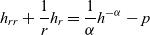 \begin{equation*}h_{rr}+\frac{1}{r}h_{r}=\frac{1}{\alpha}h^{-\alpha}-p\end{equation*}
Improved lower bound for the list chromatic number of graphs with no Kt minor
- Part of
-
- Journal:
- Combinatorics, Probability and Computing / Volume 31 / Issue 6 / November 2022
- Published online by Cambridge University Press:
- 30 May 2022, pp. 1070-1075
-
- Article
-
- You have access
- Open access
- HTML
- Export citation
-
Hadwiger’s conjecture asserts that every graph without a $K_t$-minor is $(t-1)$-colourable. It is known that the exact version of Hadwiger’s conjecture does not extend to list colouring, but it has been conjectured by Kawarabayashi and Mohar (2007) that there exists a constant $c$ such that every graph with no $K_t$-minor has list chromatic number at most $ct$. More specifically, they also conjectured that this holds for $c=\frac{3}{2}$.
Refuting the latter conjecture, we show that the maximum list chromatic number of graphs with no $K_t$-minor is at least $(2-o(1))t$, and hence $c \ge 2$ in the above conjecture is necessary. This improves the previous best lower bound by Barát, Joret and Wood (2011), who proved that $c \ge \frac{4}{3}$. Our lower-bound examples are obtained via the probabilistic method.


Transversal Ck-factors in subgraphs of the balanced blow-up of Ck
- Part of
-
- Journal:
- Combinatorics, Probability and Computing / Volume 31 / Issue 6 / November 2022
- Published online by Cambridge University Press:
- 30 May 2022, pp. 1031-1047
-
- Article
- Export citation
-
For a subgraph $G$ of the blow-up of a graph $F$, we let $\delta ^*(G)$ be the smallest minimum degree over all of the bipartite subgraphs of $G$ induced by pairs of parts that correspond to edges of $F$. Johansson proved that if $G$ is a spanning subgraph of the blow-up of $C_3$ with parts of size $n$ and $\delta ^*(G) \ge \frac{2}{3}n + \sqrt{n}$, then $G$ contains $n$ vertex disjoint triangles, and presented the following conjecture of Häggkvist. If $G$ is a spanning subgraph of the blow-up of $C_k$ with parts of size $n$ and $\delta ^*(G) \ge \left(1 + \frac 1k\right)\frac n2 + 1$, then $G$ contains $n$ vertex disjoint copies of $C_k$ such that each $C_k$ intersects each of the $k$ parts exactly once. A similar conjecture was also made by Fischer and the case $k=3$ was proved for large $n$ by Magyar and Martin.
In this paper, we prove the conjecture of Häggkvist asymptotically. We also pose a conjecture which generalises this result by allowing the minimum degree conditions in each bipartite subgraph induced by pairs of parts of $G$ to vary. We support this new conjecture by proving the triangle case. This result generalises Johannson’s result asymptotically.


HORN PROBLEM FOR QUASI-HERMITIAN LIE GROUPS
-
- Journal:
- Journal of the Institute of Mathematics of Jussieu / Volume 22 / Issue 6 / November 2023
- Published online by Cambridge University Press:
- 26 May 2022, pp. 2805-2831
- Print publication:
- November 2023
-
- Article
- Export citation
On the spectrum of non-self-adjoint Dirac operators with quasi-periodic boundary conditions
- Part of
-
- Journal:
- Proceedings of the Royal Society of Edinburgh. Section A: Mathematics / Volume 153 / Issue 4 / August 2023
- Published online by Cambridge University Press:
- 26 May 2022, pp. 1099-1117
- Print publication:
- August 2023
-
- Article
- Export citation
On tripartite common graphs
- Part of
-
- Journal:
- Combinatorics, Probability and Computing / Volume 31 / Issue 5 / September 2022
- Published online by Cambridge University Press:
- 25 May 2022, pp. 907-923
-
- Article
-
- You have access
- Open access
- HTML
- Export citation
-
A graph $H$ is common if the number of monochromatic copies of $H$ in a 2-edge-colouring of the complete graph $K_n$ is asymptotically minimised by the random colouring. Burr and Rosta, extending a famous conjecture of Erdős, conjectured that every graph is common. The conjectures of Erdős and of Burr and Rosta were disproved by Thomason and by Sidorenko, respectively, in the late 1980s. Collecting new examples of common graphs had not seen much progress since then, although very recently a few more graphs were verified to be common by the flag algebra method or the recent progress on Sidorenko’s conjecture. Our contribution here is to provide several new classes of tripartite common graphs. The first example is the class of so-called triangle trees, which generalises two theorems by Sidorenko and answers a question of Jagger, Šťovíček, and Thomason from 1996. We also prove that, somewhat surprisingly, given any tree $T$, there exists a triangle tree such that the graph obtained by adding $T$ as a pendant tree is still common. Furthermore, we show that adding arbitrarily many apex vertices to any connected bipartite graph on at most $5$ vertices yields a common graph.


On the derivative of a polynomial
- Part of
-
- Journal:
- Proceedings of the Edinburgh Mathematical Society / Volume 65 / Issue 2 / May 2022
- Published online by Cambridge University Press:
- 24 May 2022, pp. 303-310
-
- Article
- Export citation
On the sum of chemical reactions
- Part of
-
- Journal:
- European Journal of Applied Mathematics / Volume 34 / Issue 2 / April 2023
- Published online by Cambridge University Press:
- 24 May 2022, pp. 303-325
-
- Article
- Export citation
-
It is standard in chemistry to represent a sequence of reactions by a single overall reaction, often called a complex reaction in contrast to an elementary reaction. Photosynthesis $6 \text{CO}_2+6 \text{H}_2\text{O} \longrightarrow \text{C}_6\text{H}_{12}\text{O}_6 + 6 \text{O}_2$ is an example of such complex reaction. We introduce a mathematical operation that corresponds to summing two chemical reactions. Specifically, we define an associative and non-communicative operation on the product space ${\mathbb{N}}_0^n\times {\mathbb{N}}_0^n$ (representing the reactant and the product of a chemical reaction, respectively). The operation models the overall effect of two reactions happening in succession, one after the other. We study the algebraic properties of the operation and apply the results to stochastic reaction networks (RNs), in particular to reachability of states, and to reduction of RNs.

EXTENSION BETWEEN SIMPLE MODULES OF PRO-p-IWAHORI HECKE ALGEBRAS
- Part of
-
- Journal:
- Journal of the Institute of Mathematics of Jussieu / Volume 22 / Issue 6 / November 2023
- Published online by Cambridge University Press:
- 20 May 2022, pp. 2775-2804
- Print publication:
- November 2023
-
- Article
- Export citation
LOG-TRANSFORM AND THE WEAK HARNACK INEQUALITY FOR KINETIC FOKKER-PLANCK EQUATIONS
- Part of
-
- Journal:
- Journal of the Institute of Mathematics of Jussieu / Volume 22 / Issue 6 / November 2023
- Published online by Cambridge University Press:
- 16 May 2022, pp. 2749-2774
- Print publication:
- November 2023
-
- Article
- Export citation
The diameter of the uniform spanning tree of dense graphs
- Part of
-
- Journal:
- Combinatorics, Probability and Computing / Volume 31 / Issue 6 / November 2022
- Published online by Cambridge University Press:
- 13 May 2022, pp. 1010-1030
-
- Article
- Export citation
-
We show that the diameter of a uniformly drawn spanning tree of a simple connected graph on n vertices with minimal degree linear in n is typically of order $\sqrt{n}$. A byproduct of our proof, which is of independent interest, is that on such graphs the Cheeger constant and the spectral gap are comparable.

