Refine search
Actions for selected content:
9084 results in Discrete Mathematics, Information Theory and Coding
Hypergraphs without complete partite subgraphs
- Part of
-
- Journal:
- Combinatorics, Probability and Computing , First View
- Published online by Cambridge University Press:
- 11 December 2025, pp. 1-4
-
- Article
-
- You have access
- Open access
- HTML
- Export citation
-
Fix integers $r \ge 2$ and $1\le s_1\le \cdots \le s_{r-1}\le t$ and set $s=\prod _{i=1}^{r-1}s_i$. Let $K=K(s_1, \ldots , s_{r-1}, t)$ denote the complete $r$-partite $r$-uniform hypergraph with parts of size $s_1, \ldots , s_{r-1}, t$. We prove that the Zarankiewicz number $z(n, K)= n^{r-1/s-o(1)}$ provided $t\gt 3^{s+o(s)}$. Previously this was known only for $t \gt ((r-1)(s-1))!$ due to Pohoata and Zakharov. Our novel approach, which uses Behrend’s construction of sets with no 3-term arithmetic progression, also applies for small values of $s_i$, for example, it gives $z(n, K(2,2,7))=n^{11/4-o(1)}$ where the exponent 11/4 is optimal, whereas previously this was only known with 7 replaced by 721.


Sidorenko’s conjecture for subdivisions and theta substitutions
- Part of
-
- Journal:
- Combinatorics, Probability and Computing / Volume 35 / Issue 2 / March 2026
- Published online by Cambridge University Press:
- 10 December 2025, pp. 269-279
-
- Article
-
- You have access
- Open access
- HTML
- Export citation
-
The famous Sidorenko’s conjecture asserts that for every bipartite graph $H$, the number of homomorphisms from $H$ to a graph $G$ with given edge density is minimised when $G$ is pseudorandom. We prove that for any graph $H$, a graph obtained from replacing edges of $H$ by generalised theta graphs consisting of even paths satisfies Sidorenko’s conjecture, provided a certain divisibility condition on the number of paths. To achieve this, we prove unconditionally that bipartite graphs obtained from replacing each edge of a complete graph with a generalised theta graph satisfy Sidorenko’s conjecture, which extends a result of Conlon, Kim, Lee and Lee [J. Lond. Math. Soc., 2018].


On stability of rainbow matchings
- Part of
-
- Journal:
- Combinatorics, Probability and Computing / Volume 35 / Issue 2 / March 2026
- Published online by Cambridge University Press:
- 09 December 2025, pp. 255-268
-
- Article
- Export citation
-
We show that for any integer $k\ge 1$ there exists an integer $t_0(k)$ such that, for integers $t, k_1, \ldots , k_{t+1}, n$ with $t\gt t_0(k)$, $\max \{k_1, \ldots , k_{t+1}\}\le k$, and $n \gt 2k(t+1)$, the following holds: If $F_i$ is a $k_i$-uniform hypergraph with vertex set $[n]$ and more than $ \binom{n}{k_i}-\binom{n-t}{k_i} - \binom{n-t-k}{k_i-1} + 1$ edges for all $i \in [t+1]$, then either $\{F_1,\ldots , F_{t+1}\}$ admits a rainbow matching of size $t+1$ or there exists $W\in \binom{[n]}{t}$ such that $W$ intersects $F_i$ for all $i\in [t+1]$. This may be viewed as a rainbow non-uniform extension of the classical Hilton-Milner theorem. We also show that the same holds for every $t$ and $n \gt 2k^3t$, generalizing a recent stability result of Frankl and Kupavskii on matchings to rainbow matchings.


Conflict-free hypergraph matchings and coverings
- Part of
-
- Journal:
- Combinatorics, Probability and Computing / Volume 35 / Issue 2 / March 2026
- Published online by Cambridge University Press:
- 04 December 2025, pp. 230-254
-
- Article
-
- You have access
- Open access
- HTML
- Export citation
-
Recent work showing the existence of conflict-free almost-perfect hypergraph matchings has found many applications. We show that, assuming certain simple degree and codegree conditions on the hypergraph $ \mathcal{H}$ and the conflicts to be avoided, a conflict-free almost-perfect matching can be extended to one covering all vertices in a particular subset of $ V(\mathcal{H})$, by using an additional set of edges; in particular, we ensure that our matching avoids all additional conflicts, which may consist of both old and new edges. This setup is useful for various applications in design theory and Ramsey theory. For example, our main result provides a crucial tool in the recent proof of the high-girth existence conjecture due to Delcourt and Postle. It also provides a black box which encapsulates many long and tedious calculations, greatly simplifying the proofs of results in generalised Ramsey theory.


Beyond the classification theorem of Cameron, Goethals, Seidel, and Shult
- Part of
-
- Journal:
- Combinatorics, Probability and Computing / Volume 35 / Issue 2 / March 2026
- Published online by Cambridge University Press:
- 28 November 2025, pp. 207-229
-
- Article
-
- You have access
- Open access
- HTML
- Export citation
-
In 1976, Cameron, Goethals, Seidel, and Shult classified all the graphs whose smallest eigenvalue is at least $-2$ by relating such graphs to root systems that appear in the classification of semisimple Lie algebras. In this paper, extending their beautiful theorem, we give a complete classification of all connected graphs whose smallest eigenvalue lies in $(\! -\lambda ^*, -2)$, where $\lambda ^* = ho ^{1/2} + ho ^{-1/2} \approx 2.01980$, and $ho$ is the unique real root of $x^3 = x + 1$. Our result is the first classification of infinitely many connected graphs with their smallest eigenvalue in $(\! -\lambda , -2)$ for any constant $\lambda \gt 2$.


Canonization of a random circulant graph by counting walks
- Part of
-
- Journal:
- Combinatorics, Probability and Computing / Volume 35 / Issue 2 / March 2026
- Published online by Cambridge University Press:
- 26 November 2025, pp. 178-206
-
- Article
- Export citation
-
It is well known that almost all graphs are canonizable by a simple combinatorial routine known as colour refinement, also referred to as the 1-dimensional Weisfeiler–Leman algorithm. With high probability, this method assigns a unique label to each vertex of a random input graph and, hence, it is applicable only to asymmetric graphs. The strength of combinatorial refinement techniques becomes a subtle issue if the input graphs are highly symmetric. We prove that the combination of colour refinement and vertex individualization yields a canonical labelling for almost all circulant digraphs (i.e., Cayley digraphs of a cyclic group). This result provides first evidence of good average-case performance of combinatorial refinement within the class of vertex-transitive graphs. Remarkably, we do not even need the full power of the colour refinement algorithm. We show that the canonical label of a vertex $v$ can be obtained just by counting walks of each length from $v$ to an individualized vertex. Our analysis also implies that almost all circulant graphs are compact in the sense of Tinhofer, that is, their polytops of fractional automorphisms are integral. Finally, we show that a canonical Cayley representation can be constructed for almost all circulant graphs by the more powerful 2-dimensional Weisfeiler–Leman algorithm.


A rainbow Dirac theorem for loose Hamilton cycles in hypergraphs
- Part of
-
- Journal:
- Combinatorics, Probability and Computing / Volume 35 / Issue 2 / March 2026
- Published online by Cambridge University Press:
- 11 November 2025, pp. 149-177
-
- Article
- Export citation
-
A meta-conjecture of Coulson, Keevash, Perarnau, and Yepremyan [12] states that above the extremal threshold for a given spanning structure in a (hyper-)graph, one can find a rainbow version of that spanning structure in any suitably bounded colouring of the host (hyper-)graph. We solve one of the most pertinent outstanding cases of this conjecture by showing that for any $1\leq j\leq k-1$, if $G$ is a $k$-uniform hypergraph above the $j$-degree threshold for a loose Hamilton cycle, then any globally bounded colouring of $G$ contains a rainbow loose Hamilton cycle.


On higher dimensional point sets in general position
- Part of
-
- Journal:
- Combinatorics, Probability and Computing / Volume 35 / Issue 1 / January 2026
- Published online by Cambridge University Press:
- 03 November 2025, pp. 134-148
-
- Article
-
- You have access
- Open access
- HTML
- Export citation
-
A finite point set in $\mathbb{R}^d$ is in general position if no $d + 1$ points lie on a common hyperplane. Let $\alpha _d(N)$ be the largest integer such that any set of $N$ points in $\mathbb{R}^d$, with no $d + 2$ members on a common hyperplane, contains a subset of size $\alpha _d(N)$ in general position. Using the method of hypergraph containers, Balogh and Solymosi showed that $\alpha _2(N) \lt N^{5/6 + o(1)}$. In this paper, we also use the container method to obtain new upper bounds for $\alpha _d(N)$ when $d \geq 3$. More precisely, we show that if $d$ is odd, then $\alpha _d(N) \lt N^{\frac {1}{2} + \frac {1}{2d} + o(1)}$, and if $d$ is even, we have $\alpha _d(N) \lt N^{\frac {1}{2} + \frac {1}{d-1} + o(1)}$. We also study the classical problem of determining $a(d,k,n)$, the maximum number of points selected from the grid $[n]^d$ such that no $k + 2$ members lie on a $k$-flat, and improve the previously best known bound for $a(d,k,n)$, due to Lefmann in 2008, by a polynomial factor when $k$ = 2 or 3 (mod 4).


Powers of Hamilton cycles in oriented and directed graphs
- Part of
-
- Journal:
- Combinatorics, Probability and Computing / Volume 35 / Issue 1 / January 2026
- Published online by Cambridge University Press:
- 28 October 2025, pp. 101-133
-
- Article
-
- You have access
- Open access
- HTML
- Export citation
-
The Pósa–Seymour conjecture determines the minimum degree threshold for forcing the $k$th power of a Hamilton cycle in a graph. After numerous partial results, Komlós, Sárközy, and Szemerédi proved the conjecture for sufficiently large graphs. In this paper, we focus on the analogous problem for digraphs and for oriented graphs. We asymptotically determine the minimum total degree threshold for forcing the square of a Hamilton cycle in a digraph. We also give a conjecture on the corresponding threshold for $k$th powers of a Hamilton cycle more generally. For oriented graphs, we provide a minimum semi-degree condition that forces the $k$th power of a Hamilton cycle; although this minimum semi-degree condition is not tight, it does provide the correct order of magnitude of the threshold. Turán-type problems for oriented graphs are also discussed.


Disperse hypergraphs
- Part of
-
- Journal:
- Combinatorics, Probability and Computing / Volume 35 / Issue 1 / January 2026
- Published online by Cambridge University Press:
- 27 October 2025, pp. 89-100
-
- Article
-
- You have access
- Open access
- HTML
- Export citation
-
For $\ell \geq 3$, an $\ell$-uniform hypergraph is disperse if the number of edges induced by any set of $\ell +1$ vertices is 0, 1, $\ell$, or $\ell +1$. We show that every disperse $\ell$-uniform hypergraph on $n$ vertices contains a clique or independent set of size $n^{\Omega _{\ell }(1)}$, answering a question of the first author and Tomon. To this end, we prove several structural properties of disperse hypergraphs.


A note on the computational complexity of weak saturation
- Part of
-
- Journal:
- Combinatorics, Probability and Computing / Volume 35 / Issue 1 / January 2026
- Published online by Cambridge University Press:
- 16 October 2025, pp. 83-88
-
- Article
-
- You have access
- Open access
- HTML
- Export citation
-
We prove that determining the weak saturation number of a host graph $F$ with respect to a pattern graph $H$ is computationally hard, even when $H$ is the triangle. Our main tool establishes a connection between weak saturation and the shellability of simplicial complexes.


Random embeddings of bounded-degree trees with optimal spread
- Part of
-
- Journal:
- Combinatorics, Probability and Computing / Volume 35 / Issue 1 / January 2026
- Published online by Cambridge University Press:
- 13 October 2025, pp. 71-82
-
- Article
-
- You have access
- Open access
- HTML
- Export citation
-
A seminal result of Komlós, Sárközy, and Szemerédi states that any $n$-vertex graph $G$ with minimum degree at least $(1/2+\alpha )n$ contains every $n$-vertex tree $T$ of bounded degree. Recently, Pham, Sah, Sawhney, and Simkin extended this result to show that such graphs $G$ in fact support an optimally spread distribution on copies of a given $T$, which implies, using the recent breakthroughs on the Kahn-Kalai conjecture, the robustness result that $T$ is a subgraph of sparse random subgraphs of $G$ as well. Pham, Sah, Sawhney, and Simkin construct their optimally spread distribution by following closely the original proof of the Komlós-Sárközy-Szemerédi theorem which uses the blow-up lemma and the Szemerédi regularity lemma. We give an alternative, regularity-free construction that instead uses the Komlós-Sárközy-Szemerédi theorem (which has a regularity-free proof due to Kathapurkar and Montgomery) as a black box. Our proof is based on the simple and general insight that, if $G$ has linear minimum degree, almost all constant-sized subgraphs of $G$ inherit the same minimum degree condition that $G$ has.


Beyond the broken tetrahedron
- Part of
-
- Journal:
- Combinatorics, Probability and Computing / Volume 35 / Issue 1 / January 2026
- Published online by Cambridge University Press:
- 10 October 2025, pp. 59-70
-
- Article
- Export citation
-
Here we consider the hypergraph Turán problem in uniformly dense hypergraphs as was suggested by Erdős and Sós. Given a $3$-graph $F$, the uniform Turán density $\pi _{\boldsymbol{\therefore }}(F)$ of $F$ is defined as the supremum over all $d\in [0,1]$ for which there is an $F$-free uniformly $d$-dense $3$-graph, where uniformly $d$-dense means that every linearly sized subhypergraph has density at least $d$. Recently, Glebov, Král’, and Volec and, independently, Reiher, Rödl, and Schacht proved that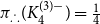 $\pi _{\boldsymbol{\therefore }}(K_4^{(3)-})=\frac {1}{4}$, solving a conjecture by Erdős and Sós. Despite substantial attention, the uniform Turán density is still only known for very few hypergraphs. In particular, the problem due to Erdős and Sós to determine $\pi _{\boldsymbol{\therefore }}(K_4^{(3)})$ remains wide open.
In this work, we determine the uniform Turán density of the $3$-graph on five vertices that is obtained from $K_4^{(3)-}$ by adding an additional vertex whose link forms a matching on the vertices of $K_4^{(3)-}$. Further, we point to two natural intermediate problems on the way to determining $\pi _{\boldsymbol{\therefore }}(K_4^{(3)})$, and solve the first of these.


Saturation in random hypergraphs
- Part of
-
- Journal:
- Combinatorics, Probability and Computing / Volume 35 / Issue 1 / January 2026
- Published online by Cambridge University Press:
- 07 October 2025, pp. 40-58
-
- Article
-
- You have access
- Open access
- HTML
- Export citation
-
Let $K^r_n$ be the complete $r$-uniform hypergraph on $n$ vertices, that is, the hypergraph whose vertex set is $[n] \, :\! = \{1,2,\ldots ,n\}$ and whose edge set is $\binom {[n]}{r}$. We form $G^r(n,p)$ by retaining each edge of $K^r_n$ independently with probability $p$. An $r$-uniform hypergraph $H\subseteq G$ is $F$-saturated if $H$ does not contain any copy of $F$, but any missing edge of $H$ in $G$ creates a copy of $F$. Furthermore, we say that $H$ is weakly $F$-saturated in $G$ if $H$ does not contain any copy of $F$, but the missing edges of $H$ in $G$ can be added back one-by-one, in some order, such that every edge creates a new copy of $F$. The smallest number of edges in an $F$-saturated hypergraph in $G$ is denoted by ${\textit {sat}}(G,F)$, and in a weakly $F$-saturated hypergraph in $G$ by $\mathop {\mbox{$w$-${sat}$}}\! (G,F)$. In 2017, Korándi and Sudakov initiated the study of saturation in random graphs, showing that for constant $p$, with high probability ${\textit {sat}}(G(n,p),K_s)=(1+o(1))n\log _{\frac {1}{1-p}}n$, and $\mathop {\mbox{$w$-${sat}$}}\! (G(n,p),K_s)=\mathop {\mbox{$w$-${sat}$}}\! (K_n,K_s)$. Generalising their results, in this paper, we solve the saturation problem for random hypergraphs $G^r(n,p)$ for cliques $K_s^r$, for every $2\le r \lt s$ and constant $p$.
$p$.


Comparing the sets of volume polynomials and Lorentzian polynomials
- Part of
-
- Journal:
- Combinatorics, Probability and Computing / Volume 35 / Issue 1 / January 2026
- Published online by Cambridge University Press:
- 19 September 2025, pp. 26-39
-
- Article
-
- You have access
- Open access
- HTML
- Export citation
-
Given $n$ convex bodies in the Euclidean space $\mathbb{R}^d$, we can find their volume polynomial which is a homogeneous polynomial of degree $d$ in $n$ variables. We consider the set of homogeneous polynomials of degree $d$ in $n$ variables that can be represented as the volume polynomial of any such given convex bodies. This set is a subset of the set of Lorentzian polynomials. Using our knowledge of operations that preserve the Lorentzian property, we give a complete classification of the cases for $(n,d)$ when the two sets are equal.


Glauber dynamics for the hard-core model on bounded-degree $H$-free graphs
- Part of
-
- Journal:
- Combinatorics, Probability and Computing / Volume 34 / Issue 6 / November 2025
- Published online by Cambridge University Press:
- 19 September 2025, pp. 803-814
-
- Article
-
- You have access
- Open access
- HTML
- Export citation
-
The hard-core model has as its configurations the independent sets of some graph instance $G$. The probability distribution on independent sets is controlled by a ‘fugacity’ $\lambda \gt 0$, with higher $\lambda$ leading to denser configurations. We investigate the mixing time of Glauber (single-site) dynamics for the hard-core model on restricted classes of bounded-degree graphs in which a particular graph $H$ is excluded as an induced subgraph. If $H$ is a subdivided claw then, for all $\lambda$, the mixing time is $O(n\log n)$, where $n$ is the order of $G$. This extends a result of Chen and Gu for claw-free graphs. When $H$ is a path, the set of possible instances is finite. For all other $H$, the mixing time is exponential in $n$ for sufficiently large $\lambda$, depending on $H$ and the maximum degree of $G$.
$G$.


An explicit economical additive basis
- Part of
-
- Journal:
- Combinatorics, Probability and Computing / Volume 34 / Issue 6 / November 2025
- Published online by Cambridge University Press:
- 12 September 2025, pp. 815-820
-
- Article
-
- You have access
- Open access
- HTML
- Export citation
-
We present an explicit subset $A\subseteq \mathbb{N} = \{0,1,\ldots \}$ such that $A + A = \mathbb{N}$ and for all $\varepsilon \gt 0$,
 \begin{equation*}\lim _{N\to \infty }\frac {\big |\big \{(n_1,n_2): n_1 + n_2 = N, (n_1,n_2)\in A^2\big \}\big |}{N^{\varepsilon }} = 0.\end{equation*}
This answers a question of Erdős.


Proper minor-closed classes of graphs have Assouad–Nagata dimension 2
- Part of
-
- Journal:
- Combinatorics, Probability and Computing / Volume 35 / Issue 1 / January 2026
- Published online by Cambridge University Press:
- 09 September 2025, pp. 1-25
-
- Article
-
- You have access
- Open access
- HTML
- Export citation
On approximability of satisfiable $\boldsymbol {k}$-CSPs: II
-
- Journal:
- Combinatorics, Probability and Computing / Volume 34 / Issue 6 / November 2025
- Published online by Cambridge University Press:
- 20 August 2025, pp. 857-926
-
- Article
- Export citation
-
Let $\Sigma$ be an alphabet and $\mu$ be a distribution on $\Sigma ^k$ for some $k \geqslant 2$. Let $\alpha \gt 0$ be the minimum probability of a tuple in the support of $\mu$ (denoted $\mathsf{supp}(\mu )$). We treat the parameters $\Sigma , k, \mu , \alpha$ as fixed and constant. We say that the distribution $\mu$ has a linear embedding if there exist an Abelian group $G$ (with the identity element $0_G$) and mappings $\sigma _i : \Sigma \rightarrow G$, $1 \leqslant i \leqslant k$, such that at least one of the mappings is non-constant and for every $(a_1, a_2, \ldots , a_k)\in \mathsf{supp}(\mu )$, $\sum _{i=1}^k \sigma _i(a_i) = 0_G$. In [Bhangale-Khot-Minzer, STOC 2022], the authors asked the following analytical question. Let $f_i: \Sigma ^n\rightarrow [\!-1,1]$ be bounded functions, such that at least one of the functions $f_i$ essentially has degree at least $d$, meaning that the Fourier mass of $f_i$ on terms of degree less than $d$ is at most $\delta$. If $\mu$ has no linear embedding (over any Abelian group), then is it necessarily the case thatwhere the right hand side
 \begin{equation*}\left | \mathop {\mathbb{E}}_{({\textbf {x}}_1, {\textbf {x}}_2, \ldots , {\textbf {x}}_k)\sim \mu ^{\otimes n}}[f_1({\textbf {x}}_1)f_2({\textbf {x}}_2)\cdots f_k({\textbf {x}}_k)] \right | = o_{d, \delta }(1),\end{equation*} $\to 0$ as the degree $d \to \infty$ and $\delta \to 0$?
In this paper, we answer this analytical question fully and in the affirmative for $k=3$. We also show the following two applications of the result.
1. The first application is related to hardness of approximation. Using the reduction from [5], we show that for every $3$-ary predicate $P:\Sigma ^3 \to \{0,1\}$ such that $P$ has no linear embedding, an SDP (semi-definite programming) integrality gap instance of a $P$-Constraint Satisfaction Problem (CSP) instance with gap $(1,s)$ can be translated into a dictatorship test with completeness $1$ and soundness $s+o(1)$, under certain additional conditions on the instance.
2. The second application is related to additive combinatorics. We show that if the distribution $\mu$ on $\Sigma ^3$ has no linear embedding, marginals of $\mu$ are uniform on $\Sigma$, and $(a,a,a)\in \texttt{supp}(\mu )$ for every $a\in \Sigma$, then every large enough subset of $\Sigma ^n$ contains a triple $({\textbf {x}}_1, {\textbf {x}}_2,{\textbf {x}}_3)$ from $\mu ^{\otimes n}$ (and in fact a significant density of such triples).


Embedding nearly spanning trees
- Part of
-
- Journal:
- Combinatorics, Probability and Computing / Volume 34 / Issue 6 / November 2025
- Published online by Cambridge University Press:
- 11 August 2025, pp. 927-931
-
- Article
- Export citation
-
The Erdős-Sós Conjecture states that every graph with average degree exceeding $k-1$ contains every tree with $k$ edges as a subgraph. We prove that there are $\delta \gt 0$ and $k_0\in \mathbb N$ such that the conjecture holds for every tree $T$ with $k \ge k_0$ edges and every graph $G$ with $|V(G)| \le (1+\delta )|V(T)|$.


