To save content items to your account,
please confirm that you agree to abide by our usage policies.
If this is the first time you use this feature, you will be asked to authorise Cambridge Core to connect with your account.
Find out more about saving content to .
To save content items to your Kindle, first ensure no-reply@cambridge.org
is added to your Approved Personal Document E-mail List under your Personal Document Settings
on the Manage Your Content and Devices page of your Amazon account. Then enter the ‘name’ part
of your Kindle email address below.
Find out more about saving to your Kindle.
Note you can select to save to either the @free.kindle.com or @kindle.com variations.
‘@free.kindle.com’ emails are free but can only be saved to your device when it is connected to wi-fi.
‘@kindle.com’ emails can be delivered even when you are not connected to wi-fi, but note that service fees apply.
This study aimed to explore extracellular microRNA derived from Echinococcus multilocularis (EM) in the plasma of patients with alveolar echinococcosis (AE) and assess its potential as a diagnostic biomarker. EM-derived miRNAs were identified in plasma samples from 20 AE patients through miRNA sequencing. Three novel miRNA molecules (emu-miR-novel 1, 2 and 3) were predicted through bioinformatic analysis to elucidate their chromosomal locations, secondary structures and precursor forms. Subsequently, plasma samples from 30 AE patients and 30 controls were utilized to establish an assay via stem-loop reverse transcription PCR, optimizing primers, reaction systems, and conditions to assess cross-reactivity and sensitivity. Clinical validation revealed that emu-miR-novel 1 had the highest diagnostic accuracy, with an area under the curve (AUC) of 0.8994, a P value of less than 0.0001, a sensitivity of 83.3%, and a specificity of 86.7%. Statistically significant differences were observed between the groups for emu-miR-novel 1 (P < 0.05), whereas emu-miR-novel 2 and 3 showed AUC values of 0.7922 and 0.6883, with P values of 0.0001 and 0.012, respectively, indicating no significant difference between groups (P > 0.05). Furthermore, the assay showed no cross-reactivity with samples from 18 common viruses, 4 parasitic infections, and miRNAs from AE sequenced from 8 species, confirming its high specificity. Emu-miR-novel 1 exhibited a sensitivity of 1 femtomolar. Emu-miR-novel 1 holds promise as a key diagnostic tool for AE, offering a novel perspective and approach for disease diagnosis.
To address the global challenge of plastic waste, 175 UN Member States are negotiating a legally binding instrument, the Plastic Treaty, aimed at ending plastic pollution. This ambitious framework, targeting both terrestrial and marine sources, is being developed through Intergovernmental Negotiating Committee meetings scheduled to conclude by 2025. Amidst uncertainties and power dynamics influencing state positions, this research identifies 10 critical, yet unresolved, points within the treaty negotiations (i.e., the scope of the treaty, equity and differentiation, involvement of non-state actors, integration with existing agreements, standards and specifications, trade implications, monitoring and reporting, responsibility and historical contributions, binding vs. non-binding commitments, and financing and technology transfer). The findings suggest potential compromises in the treaty’s environmental provisions, influenced by domestic interests and international power disparities. As negotiations progress, the imperative for cooperation and decisive action against plastic pollution becomes increasingly pressing, challenging member states to prioritize global environmental integrity over national interests.
Antimicrobial resistance (AMR) renders many bacterial infections untreatable and results in substantial morbidity and mortality worldwide. Understanding antibiotic use in clinical settings including hospitals is critical to optimize antibiotic use and prevent resistance.
Design:
Hospital antibiotic point prevalence survey (PPS).
Methods:
The study was conducted in two large, teaching hospitals in Addis Ababa, Ethiopia. We performed two survey rounds in December 2021 and January 2022 through real-time chart review using the World Health Organization PPS methodology. Data were collected using a web-based database, and descriptive statistics were performed to analyze antibiotic use by various characteristics.
Results:
Among 1020 hospitalized patients, 318 (32%) were ≤14 years and 370 (36%) had surgery during the current hospitalization. A total of 662 (65%) were receiving an antibiotic on the day of survey and 346 (39%) were receiving ≥2 antibiotics. A community-acquired infection (43%) was the most common indication for an antibiotic followed by surgical prophylaxis (27%) and hospital-acquired infection (23%). Antibiotic use was highest among those ≤24 months in age and among patients in trauma, surgical, and pediatric wards. Cephalosporin (42%) and penicillin (16%) antibiotics were the most frequently prescribed classes. Only 11% of patients on antibiotics had samples collected for microbiological testing; hence, almost all antibiotic therapy was empiric.
Conclusions:
Despite global and national efforts to improve antimicrobial stewardship, antibiotic use remains high in urban teaching hospitals in Ethiopia. Implementation of antimicrobial stewardship activities and microbiology utilization are needed to guide antimicrobial selection and curtail antibiotic overuse.
I would like to thank the editors of Nationalities Papers for providing a forum for the discussion of my book and for facilitating the symposium. I would also like to express my deep gratitude to Lisa Blaydes, Anastasia Shesterinina, and Dan Slater for taking the time to read the book and for offering their insightful comments and questions. Their scholarship was an inspiration and a source of wisdom for my research in almost all its aspects, from the art of theory-building to their methodological input on survey research and qualitative fieldwork (Belge and Blaydes 2014; Blaydes 2018; Shesterinina 2019, 2021; Slater 2010). It was a wonderful feeling to read their engagement with my work. I believe that the ways the authors of the symposium presented some of the central ideas of my book were often better than the ways I did it myself. In this response, I’ll address some of the central questions and comments raised by the reviewers.
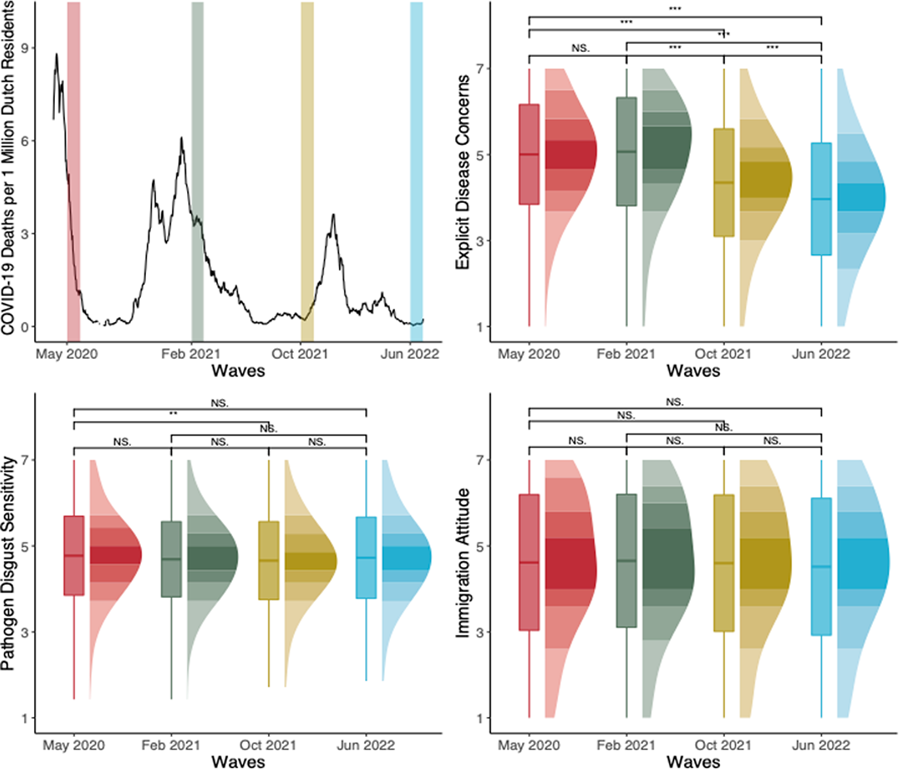
Multiple proposals suggest that xenophobia increases when infectious disease threats are salient. The current longitudinal study tested this hypothesis by examining whether and how anti-immigrant sentiments varied in the Netherlands across four time points during the COVID-19 pandemic (May 2020, February 2021, October 2021 and June 2022 through Flycatcher.eu). The results revealed that (1) anti-immigrant sentiments were no higher in early assessments, when COVID-19 hospitalizations and deaths were high, than in later assessments, when COVID-19 hospitalizations were low, and (2) within-person changes in explicit disease concerns and disgust sensitivity did not relate to anti-immigrant sentiments, although stable individual differences in disgust sensitivity did. These findings suggest that anecdotal accounts of increased xenophobia during the pandemic did not generalize to the population sampled from here. They also suggest that not all increases in ecological pathogen threats and disease salience increase xenophobia.
The Dispute Settlement Mechanism (DSM), once regarded as the jewel in the crown of the World Trade Organization (WTO), has been facing a variety of serious criticisms for its inherent limitations and problems while its appellate review function has been paralyzed. Discussions on the reform of the WTO DSM have been under way for several years now. Many key items are on the reform agenda, one of which is to introduce Alternative Dispute Resolution (ADR) proceedings to the WTO DSM. Among several options of ADR, ‘mediation’ can offer an important set of tools for the WTO and its Members to resolve disputes in a more efficient and prompt manner. If properly structured, mediation can complement the existing binding proceedings of panels and the Appellate Body. At the same time, introduction of mediation to the WTO DSM may also cause additional legal and practical problems. It may cause further delays, confidentiality traps, due process myriads, and enforcement loopholes. It is vital to introduce mediation provisions to address those critical problems. Systematized and structuralized mediation in the WTO DSM will be able to offer a viable alternative path to resolve certain complex and sensitive disputes.
This article deals with the confiscation of property from the German-speaking inhabitants of Czechoslovakia and its redistribution to the new settlers of the Czech borderlands. It shows how the social revolution—that is, the emergence of an egalitarian postwar society—was made possible by the national revolution—that is, the expulsion of the German-speaking inhabitants of Central Europe. Using the example of the industrial center of Liberec in northern Bohemia, the author shows how the Czech administration that was established after the Second World War applied the dichotomy of the Czech–German conflict to an ethnically complex postwar society and how, despite the ideology of distributing property to the “Slavs,” non-Czech minorities were discriminated against with respect to redistribution. Eventually, she analyzes how postwar Czechoslovak society was shaped, with an emphasis on the material demands of workers and collectives, even as individuals sought to achieve a middle-class lifestyle through participation in property distribution.
No cooperative scheme in EU law has displayed bigger tensions between mutual trust and fundamental rights protection than the EAW system. Despite the requirement developed by the CJEU for national courts to trust each other and recognise each other’s arrest warrants, the reality on the ground has shown high levels of distrust between national courts regarding Member States’ alignment with core EU values. In this contribution, we analyze how the CJEU has managed such tensions in the EAW system. To that effect, we first put the Court’s EAW case law into context by examining the broader language of mutual trust used by the Court in other fields of EU law. In doing so, we point out how the Court has espoused different levels of lawful distrust to be exercised in different circumstances under the scope of application of mutual trust. Given that broader context, it is contradictory for the Court to mainly view mutual trust as a requirement rather than a reality in need of permanent and continuing justification between national authorities. The latter conception of mutual trust is more apt to be the basis of EU horizontal cooperation, which must be value-based and sincere according to the Treaties. Therefore, we propose a bidimensional account of mutual trust as a legal principle, one that accommodates both trust and distrust as tools for managing the uncertainty and dynamic nature of trust-based cooperation. Finally, we explore how such account of mutual (dis)trust can be concretised by the Court and other political institutions.
The crisis over Salman Rushdie’s novel The Satanic Verses exposed the contrasting ways Western and Muslim actors understand the place of religion in international order and the responsibilities of states in religious controversies. No other Muslim national leader supported Ayatollah Khomeini’s call for Rushdie’s death in 1989, but many Muslims expressed anger and disbelief that Britain and Western powers could not restrict a book that caused so much international disturbance. This paper seeks to understand this discord through the overlapping but conflicted language games of Western and Muslim national leaders. It analyses a previously unreported exchange of letters between British prime minister Margaret Thatcher and Malaysian prime minister Mahathir Mohamad, along with other recently released archival material from the diplomatic crisis. These letters reflected different unwritten rules informing the actors’ understandings and practices of international order, despite their shared acceptance of the sovereignty of national states. For Mahathir, the Western world was itself a religious identity, and its collective propagation of The Satanic Verses compounded a religious insult to the Muslim world. But Thatcher and other British actors did not see religious identities, especially their own, as basic elements of international relations, instead reasserting the secular primacy of national states.
The burgeoning nineteenth-century public-museum sector built a significant part of its natural-history specimen collections through extensive international trading. The early 2020s has seen an upsurge of scholarly interest in this largely overlooked trade. Exchange was a distinctive aspect of the natural-history trade that reveals much about the diverse practices and motives of the institutional collectors. Economic-geographic benefits included conserving the limited financial resources of museums and exploiting complementarities in the geographic distribution of specimens. Collection management, institutional reputation, social connection and international diplomacy were also part of a complex mix of value making that shaped this important international trade. We analyse the exchange practices of the three largest museums in the Australian colonies in the final three decades of the nineteenth century who exchanged Australia’s ‘rare and curious’ fauna with collectors across the globe. By deploying and analysing extensive, comparative data on a particular form of natural history, zoology, and a particular kind of trade, exchange trading, among three Australian museums, this paper extends and enriches recent scholarship on the mobility of natural-history specimens and how they were traded.
To evaluate the impact of a counselling programme to strengthen the health and nutrition behaviours of caregivers of children under 2 and the sustainability of that impact through reduced intervention intensity one year later.
Design:
The programme trained community- and facility-based health staff to provide nutrition counselling. We conducted an impact evaluation with a modified stepped-wedge design using difference-in-differences analysis to compare indicator changes in an intervention group to a comparison group (midterm survey) and then a full intervention group to a light intervention group (final survey).
Setting:
Batken and Jalal-Abad oblasts, the Kyrgyz Republic, 2020–2023.
Participants:
Caregivers of children under 2 provided 6253 responses in three telephone surveys.
Results:
We observed statistically significant differences between the intervention and comparison groups at midterm for the percentage of children consuming vitamin A-rich foods; an increase in the intervention group (58–62 %) and a decrease in the comparison group (61–57 %). We observed similar results with exclusive breastfeeding (51–55 % in the intervention group and 48–40 % in the comparison group). There were also positive differences in other health and nutrition indicators. With the final survey results, in general, we observed statistically significant differences indicating a bigger change in full intervention areas compared to light intervention areas. We observed small negative changes in many indicators in light intervention areas.
Conclusions:
This evaluation highlights the importance of continued support for local interventions, particularly counselling programmes, to foster optimal nutrition behaviours.
Urban logistics has emerged as a priority to improve goods distribution and mobility within urban centers worldwide. Brazil presents a unique set of challenges in this regard due to issues such as excessive reliance on road transportation, lack of regulations, inadequate infrastructure, cargo theft, and the intricate interplay of cargo transportation with urban traffic. These challenges collectively exert a substantial influence on the economic, urban, and environmental performance of cities. This article introduces a novel approach aimed at assessing and benchmarking urban logistics performance between Brazilian cities with potential applicability to other contexts. The methodology was based on data envelopment analysis to evaluate efficiency based on key indicators, including GDP Gross Domestic Product, population size, commercial establishments, urban area coverage, cargo fleet size, and travel time. By applying this methodology to 12 Brazilian cities, the study improves the understanding of their relative efficiency levels concerning urban logistics and provides key insights for policymaking. The results also show the relevance of the proposed methodology and contribute to provide a perspective of different administrative and logistical facets through the lens of macroeconomic indicators, contributing to a holistic understanding of urban logistics dynamics.
John Stuart Mill is central to parallel debates in mainstream contemporary political epistemology and philosophy of federalism concerning the epistemic dimension(s) of legitimate authority. Many scholars invoke Mill to support epistemic arguments for democratic decision-making and decentralized federalism as a means of conferring democratic legitimacy. This article argues that Millian considerations instead provide reason to reject common epistemic arguments for decentralized federalism. Combining Mill's own insights about the epistemic costs of decentralization and recent work in philosophy, politics, and economics undermines purportedly Millian arguments for federalism focused on political experimentation, diversity and participation. Contrary to many interpretations, Millian considerations weaken, rather than strengthen, arguments for federalism. Any valid justification for federalism must instead rest on non-epistemic considerations. This conclusion is notable regardless of how one interprets Mill. But it also supports Mill's stated preference for local decisions subject to central oversight.
We draw from the Health Technology Assessment (HTA) literature to propose how hospitals and local health networks can prepare the key components of early economic evaluations to support the development and management of health service interventions.
Methods
Using the case example of a proposed intervention for older people in the Emergency Department (ED), a conceptual logic model of a new health service intervention is articulated to inform the structuring and population of a decision-analytic model using observed data on the existing care comparator and structured elicitation exercise of initial stakeholder expectations of intervention effects.
Results
The elicited patient pathway probabilities and lengths of stay quantities profile which of the existing types of patients are expected to avoid the ED and how this impacts the lengths of stay across the system. The exercise also quantifies the stakeholders’ uncertainty and disagreement, with qualitative insights into why. The elicitation exercise participants draw upon the rationale for how the intervention is expected to affect a change within the local context, as captured within the logic model, together with the descriptive analyses of the characteristics and utilization of their target population. Feedback indicates the methods are acceptably robust yet pragmatic enough for healthcare delivery settings.
Conclusions
As proposed in this paper, HTA methods can be used to capture how key stakeholders initially expect a service intervention to affect a change within their local context. The example results can be used in a decision-analytic model to guide the development and management of an intervention.
This article aims to analyze the impact of memory on security/foreign policy using the example of Serbia and Bosnia and Herzegovina’s bilateral relations. The basis for these considerations is the concept of ontological security. It indicates the construction of the identity of the state and is implemented through political decisions and social practices (for example remembering important historical events). Here, memory is treated as a social construct. In addition, the article focuses on memory leading to the formation of state identity, also seen in the international sphere. Historical memory has a considerable impact on bilateral relations between countries that used to be in conflict, like Serbia and BiH. In the example analyzed, leaders use historical memory to create separate identities, commemorate chosen and appropriate victims/heroes or important dates, historical sites, monuments events and develop selective narratives. The most significant elements in the analysis of the historical memory of Serbia and BiH relations are (1) the goals of foreign and security policy of Serbia and BiH (2) the contemporary narrative of the Srebrenica genocide and its perception by governments of Serbia, BiH, and by Bosnian Serbs and Bosniaks, and (3) an official Srebrenica commemoration (memorials, Srebrenica Memorial Day).
This paper examines how Britain, through ‘gunboat diplomacy’ campaigns against so-called Arab pirates, overran the pre-existing Gulf suzerain system and became the predominant power in its waters. By filling a gap in the classical English School ‘international society’ expansion thesis, this article describes how and when political and ideational shifts in the Gulf allowed sovereignty to manifest into its present dynastic form. It argues British imposition of rules, norms, and institutions through a series of nineteenth-century Anglo-Arab treaties against Arab ‘pirates’ broke traditional conditions of divisible sheikhly authority to embed a new telos of sovereign indivisibility, facilitating indirect colonisation. Colonialism as an overlooked primary institution in the classical international society expansion story reinforced political inequality to create dynasticism to simplify colonial statecraft. The 1836 Restrictive Line was a central institution introduced by Britain to manage the transition from divisible to indivisible authority. Drawing from colonial archives, the paper argues that British control over cross-coastal movements through a Restrictive Line reinforced domestic sovereignty of British treaty signatories while weakening agency of maritime sheikhs outside the Anglo-Arab treaties framework. This unsettled traditional structures, transforming maritime tribal confederacies from participation to compliance and reconfiguring Gulf coastal security imperatives for treaty-signatory sheikhs from sea to desert.
Recently, deep learning methods have achieved remarkable success in the Chinese word segmentation (CWS) task. Some of them enhance the CWS model by utilizing contextual features and external resources (e.g., sub-words, lexicon, and syntax). However, existing approaches fail to fully use the heterogeneous features and their structural information. Therefore, in this paper, we propose a heterogeneous information learning framework for CWS, named heterogeneous graph neural segmenter (HGNSeg), which exploits heterogeneous features with the graph convolutional networks and the pretrained language model. Experimental results on six benchmark datasets (e.g., SIGHAN 2005 and SIGHAN 2008) confirm that HGNSeg can effectively improve the performance of CWS. Importantly, HGNSeg also demonstrates an excellent ability to alleviate the out-of-vocabulary (OOV) issue in cross-domain scenarios.
Scenario–neutral methods are commonly used to rapidly compare system responses to changes in climate. Using glacier mass balance as a system response, we present a bottom-up, scenario–neutral method as an effective tool for preliminary and overview studies on glacier sensitivity and a complementary approach to traditional top–down methods. The method's main characteristic is its visual result: two–dimensional response surfaces depicting glacier mass balance. Their axes represent perturbations in temperature and precipitation relative to a baseline. The simplicity of our approach makes it applicable to all global glaciers. As a proof–of–concept, the Open Global Glacier Model (OGGM) is used to perform a scenario–neutral glacier sensitivity analysis for four glaciers. In addition, the integration with a top–down approach is demonstrated by overlaying temperature and precipitation from four Coupled Model Intercomparison Project Phase 6 (CMIP6) models, under four Shared Socioeconomic Pathways (SSP). Finally, the benefits of the method are discussed for decision–making and science communication. Assessing results shows that overall, this scenario–neutral method can provide useful information for the research of climate change impact on glacier mass, from aiding study design to science communication.
While we know that the far right thrives when migration is salient in public agendas, what happens when this issue is no longer under the spotlight? Building on 25 face-to-face interviews with activists mobilized against migration during COVID-19 in Italy, this article explores far-right framing of migration as a non-salient issue. We find that far-right groups indeed reframe their messages vis-à-vis a less favourable political setting; yet they are also able to seize fresh opportunities to reactivate opposition to migration, notably via prognostic frames delivering ostensibly depoliticized views that hijack solidarity principles and emphasize pragmatic and technocratic approaches to border control and migration management. In uncovering the discursive strategies used by far-right actors to bolster their credibility and appeal when out of their comfort zone, this article contributes to the scholarly understanding of politicization and highlights the mechanisms by which far-right ideas are becoming normalized in the public sphere.
Translingual knowledge allows sociolinguists to appreciate more ‘playful’ negotiation and the assemblages of linguistic, cultural, and semiotic resources for meaning-making. Yet, this very idea of ‘translingual playfulness’ should never lose sight of the subversive purpose of this apparent playfulness: to destabilise norms and boundaries. The reason behind all of this translingual playfulness is precisely the ‘precarious’ positions of the creators of the playful. In this article, I urge sociolinguists to think more carefully about how translingual playfulness may connect to precarity and argue that it is important not to construe playfulness and precarity as dichotomous or even as opposite ends of a spectrum but rather to view them as symbiotically (re)constituting each other. The idea of ‘precarity’, thereby, deserves much more attention than the representation of ‘playfulness’; that is, explicit/implicit translingual precarity needs to be revealed in translingual scholarship. (Translingualism, playfulness, precarity)*