Refine search
Actions for selected content:
26063 results in Abstract analysis
5 - Carleson Embedding Point of View
-
- Book:
- A Primer, and Beyond, on Composition Operators on the Unit Disk
- Published online:
- 15 May 2026
- Print publication:
- 11 June 2026, pp 172-213
-
- Chapter
- Export citation
Cognitive diffusion of susceptibles driven by new infection cases in SIS epidemic models: frequency-dependent incidence
- Part of
-
- Journal:
- European Journal of Applied Mathematics , First View
- Published online by Cambridge University Press:
- 10 June 2026, pp. 1-29
-
- Article
-
- You have access
- Open access
- HTML
- Export citation
PCR-Kähler equivalent metrics in the Siegel domain
- Part of
-
- Journal:
- Glasgow Mathematical Journal , First View
- Published online by Cambridge University Press:
- 08 June 2026, pp. 1-19
-
- Article
-
- You have access
- HTML
- Export citation
ACS condition on minimal isoparametric hypersurfaces of positive Ricci curvature in unit spheres
- Part of
-
- Journal:
- Glasgow Mathematical Journal , First View
- Published online by Cambridge University Press:
- 08 June 2026, pp. 1-12
-
- Article
- Export citation
-
We study the Ambrozio–Carlotto–Sharp (ACS) criterion on minimal isoparametric hypersurfaces $N^{n+1}\subset S^{n+2}$ with positive Ricci curvature, motivated by the Schoen–Marques–Neves conjecture on Morse index. For $g=4$ distinct principal curvatures with multiplicities $m_1,m_2$, we prove that the pointwise ACS inequality holds if and only if $\min \{m_1,m_2\}\ge 4$. Sufficiency is obtained via a moment-relaxation technique yielding the sharp bound $4a^2$ on the quadratic part of the integrand; necessity follows from an explicit extremal configuration in the top eigenspace of the shape operator. We also verify the ACS condition for $g=3$ with $m_1=m_2\in \{4,8\}$. As a consequence, for any closed embedded minimal hypersurface $M^n$ in such an ambient manifold, $\operatorname {index}(M)\ge \tfrac {2}{d(d-1)}\, b_1(M)$ with $d=n+3$.


TOPOLOGICAL AND DYNAMICAL ASPECTS OF SOME SPECTRAL INVARIANTS OF CONTACT MANIFOLDS WITH A CIRCLE ACTION
- Part of
-
- Journal:
- Journal of the Institute of Mathematics of Jussieu , First View
- Published online by Cambridge University Press:
- 08 June 2026, pp. 1-39
-
- Article
- Export citation
Trees and treelike structures in dense digraphs
- Part of
-
- Journal:
- Combinatorics, Probability and Computing , First View
- Published online by Cambridge University Press:
- 04 June 2026, pp. 1-38
-
- Article
-
- You have access
- Open access
- HTML
- Export citation
-
We prove that every oriented tree on $n$ vertices with bounded maximum degree appears as a spanning subdigraph of every directed graph on $n$ vertices with minimum semidegree at least $n/2+{\mathrm{o}}(n)$. This can be seen as a directed graph analogue of a well-known theorem of Komlós, Sárközy, and Szemerédi. Our result for trees follows from a more general result, allowing the embedding of arbitrary orientations of a much wider class of spanning ‘tree-like’ structures, such as collections of at most $O(n^{0.99})$ pairwise vertex-disjoint cycles and subdivisions of graphs $H$ with $|H|\lt \exp \bigl (\sqrt {\textrm {O}(\log n)}\,\bigr )$ in which each edge is subdivided at least once.


Isoperimetric inequality for nearly spherical domains in the Bergman ball $\mathbb{B}_2$
- Part of
-
- Journal:
- Proceedings of the Royal Society of Edinburgh. Section A: Mathematics , First View
- Published online by Cambridge University Press:
- 04 June 2026, pp. 1-25
-
- Article
- Export citation
-
We prove a quantitative isoperimetric inequality for nearly spherical domains in the Bergman ball in $\mathbb{C}^2$. We prove a Fuglede-type theorem for such sets. This result is a counterpart of a similar result obtained for the hyperbolic unit ball, and it provides the first result on the isoperimetric phenomenon in the Bergman ball.


Dimension reduction and homogenization for thin plates with disconnected rigid inclusions
- Part of
-
- Journal:
- Proceedings of the Royal Society of Edinburgh. Section A: Mathematics , First View
- Published online by Cambridge University Press:
- 03 June 2026, pp. 1-60
-
- Article
-
- You have access
- HTML
- Export citation
-
This paper addresses the simultaneous homogenization and dimension reduction of thin composite plates reinforced with rigid substructures, within the framework of non-linear elasticity. The reference (undeformed) configuration consists of a periodically perforated elastic matrix, where the holes are occupied by rigid inclusions. We first establish a decomposition of the deformation for such composite structures. Under the assumption that the thickness parameter $\delta$ is asymptotically smaller than the periodicity $\varepsilon$, we derive a reduced asymptotic model as both parameters tend to zero. Using rescaled unfolding operators, we characterize the limiting behaviour of the Green–St. Venant strain tensor. Through $\Gamma$-convergence, we obtain the homogenized limit energy and establish the existence of a minimizer. The resulting limit model is of constrained Kármán type, where the limiting displacement satisfies a first-order infinitesimal isometry constraint.


A Becker–Döring model with injection and irreversible fragmentation
- Part of
-
- Journal:
- European Journal of Applied Mathematics , First View
- Published online by Cambridge University Press:
- 03 June 2026, pp. 1-36
-
- Article
-
- You have access
- Open access
- HTML
- Export citation
HERMITIAN DUALS AND GENERIC REPRESENTATIONS FOR AFFINE HECKE ALGEBRAS
- Part of
-
- Journal:
- Journal of the Institute of Mathematics of Jussieu , First View
- Published online by Cambridge University Press:
- 03 June 2026, pp. 1-49
-
- Article
-
- You have access
- Open access
- HTML
- Export citation
Intermediate dimensions of complementary sets
- Part of
-
- Journal:
- Proceedings of the Royal Society of Edinburgh. Section A: Mathematics , First View
- Published online by Cambridge University Press:
- 02 June 2026, pp. 1-19
-
- Article
- Export citation
-
Given a positive, non-increasing sequence $a$ with finite sum equal to $1$, we consider the family of all closed subsets of $[0,1]$ whose complementary open intervals have lengths given by a rearrangement of the sequence $a$. We study the full range of possible $\theta$-intermediate dimensions of these sets and, under suitable assumptions on the sequence, we show that this range forms a closed interval, whose endpoints we compute explicitly. This paper fills a gap in the literature concerning the dimensional properties of complementary sets.


ON THE TORSION LOCUS OF THE CERESA NORMAL FUNCTION
- Part of
-
- Journal:
- Journal of the Institute of Mathematics of Jussieu , First View
- Published online by Cambridge University Press:
- 01 June 2026, pp. 1-19
-
- Article
-
- You have access
- Open access
- HTML
- Export citation
-
We prove that the positive-dimensional part of the torsion locus of the Ceresa normal function in $\mathcal {M}_g$
 is not Zariski dense when $g\geq 3$
 . Moreover, it has only finitely many components with generic Mumford-Tate group equal to $\mathrm {GSp}_{2g}$
 ; these components are defined over $\overline {\mathbb Q}$
 , and their union is closed under the action of $\mathrm {Gal}(\overline {\mathbb Q}/\mathbb Q)$
 . More generally, we study the distribution of the torsion locus of arbitrary admissible normal functions.


Counting rational points close to p-adic integers and applications in Diophantine approximation
- Part of
-
- Journal:
- Glasgow Mathematical Journal , First View
- Published online by Cambridge University Press:
- 01 June 2026, pp. 1-21
-
- Article
- Export citation
-
We find upper and lower bounds on the number of rational points with bounded denominators that are contained in a rectangular neighbourhood of some $n$-dimensional $p$-adic integer. To find the upper bound, we use lattice point counting techniques on $p$-adic approximation lattices, and for the corresponding lower-bound statement, a classical pigeonhole principle-style argument is used. We apply this counting result to prove a statement in the setting of weighted simultaneous $p$-adic Diophantine approximation on coordinate hyperplanes. For the lower-bound Hausdorff dimension result, we construct a local ubiquitous system of rectangles and then apply the recent Mass Transference Principle result of Wang and Wu (Math. Ann., 2021).


Integrability of the Fourier transform via Riesz derivative
- Part of
-
- Journal:
- Glasgow Mathematical Journal , First View
- Published online by Cambridge University Press:
- 29 May 2026, pp. 1-8
-
- Article
- Export citation
-
A known condition for the integrability of the one-dimensional Fourier transform, in which the derivative is assumed to belong to the real Hardy space, is extended to the $n$-dimensional case, in terms of the $n$-th Riesz derivative. We obtain results for the Riesz derivatives of other orders. The function spaces involved in this study are compared and analyzed.


Counting fixed-point-free Cayley permutations
- Part of
-
- Journal:
- Proceedings of the Edinburgh Mathematical Society , First View
- Published online by Cambridge University Press:
- 28 May 2026, pp. 1-34
-
- Article
- Export citation
-
Two-sort species yield differential equations for functional digraphs of Cayley permutations. From these, we obtain an explicit formula for fixed-point-free Cayley permutations and prove that their proportion tends to $1/e$, as for permutations and endofunctions. Our approach also yields counting formulas when the functional digraph is a tree, forest, or connected.

GENERALIZED FOLIATIONS FOR HOMEOMORPHISMS ISOTOPIC TO A PSEUDO-ANOSOV HOMEOMORPHISM: A GEOMETRIC REALIZATION OF A RESULT BY FATHI
- Part of
-
- Journal:
- Journal of the Institute of Mathematics of Jussieu , First View
- Published online by Cambridge University Press:
- 28 May 2026, pp. 1-15
-
- Article
-
- You have access
- Open access
- HTML
- Export citation
A characterization of quasi-homogeneity in terms of liftable vector fields – ERRATUM
-
- Journal:
- Proceedings of the Royal Society of Edinburgh. Section A: Mathematics , First View
- Published online by Cambridge University Press:
- 28 May 2026, p. 1
-
- Article
-
- You have access
- Open access
- HTML
- Export citation
Modelling the evolutionary dynamics of insecticide quantitative resistance in mosquito populations
- Part of
-
- Journal:
- European Journal of Applied Mathematics , First View
- Published online by Cambridge University Press:
- 26 May 2026, pp. 1-30
-
- Article
-
- You have access
- Open access
- HTML
- Export citation
Cooper–Hirschhorn type identities for three or more squares. III
- Part of
-
- Journal:
- Proceedings of the Edinburgh Mathematical Society , First View
- Published online by Cambridge University Press:
- 22 May 2026, pp. 1-22
-
- Article
- Export citation
-
Let $r_s(n)$ denote the number of representations of $n$ as a sum of $s$ squares. Hurwitz established eleven identities expressing the generating function of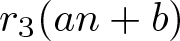 $r_3(an+b)$ as a simple infinite product. Cooper and Hirschhorn (Discrete Math 274 (1-3):9–24, 2004) proved that for any $k\geq0$, the generating functions $\sum_{n=0}^\infty r_3\big(3^{2k}n\big)q^n$ and $\sum_{n=0}^\infty r_3\big(3^{2k+1}n\big)q^n$ can be written as linear combinations of two specified generalized eta-quotients. In this paper, we substantially extend these results to high dimensions. Specifically, we prove that for any $k\geq0$ and $3\leq s\leq 100$, the generating functions $\sum_{n=0}^\infty r_s\big(3^{2k+1}n\big)q^n$ and $\sum_{n=0}^\infty r_s\big(3^{2k+2}n\big)q^n$ can also be expressed as linear combinations of certain generalized eta-quotients. Motivated by these results, we conjecture that this phenomenon holds for $r_s(n)$ for all $s\geq3$, and further that $r_s(n)$ satisfies an infinite family of internal congruences modulo high powers of $3$.
$3$.


C1 solutions of a general cohomological equation on the plane
- Part of
-
- Journal:
- Proceedings of the Edinburgh Mathematical Society , First View
- Published online by Cambridge University Press:
- 22 May 2026, pp. 1-15
-
- Article
-
- You have access
- HTML
- Export citation
-
Cohomological equation is of special interest because it concerns the study of time change for flows, topological stability and topological conjugacy in dynamical systems, which is also an auxiliary equation to study the problem of linearization. In this paper, we consider a general form of cohomological equation for planar contractions. By using the ideas of invariant manifold and estimations in [W. Zhang and W. Zhang, $C^1$ linearization for planar contractions, J. Funct. Anal. 260 (2011), 2043–2063.], we present new criteria on eigenvalues of the linear parts for the existence of $C^1$ solutions in the Poincaré domain. Our results are a generalization of $C^1$ linearization for contractions.


