To save content items to your account,
please confirm that you agree to abide by our usage policies.
If this is the first time you use this feature, you will be asked to authorise Cambridge Core to connect with your account.
Find out more about saving content to .
To save content items to your Kindle, first ensure no-reply@cambridge.org
is added to your Approved Personal Document E-mail List under your Personal Document Settings
on the Manage Your Content and Devices page of your Amazon account. Then enter the ‘name’ part
of your Kindle email address below.
Find out more about saving to your Kindle.
Note you can select to save to either the @free.kindle.com or @kindle.com variations.
‘@free.kindle.com’ emails are free but can only be saved to your device when it is connected to wi-fi.
‘@kindle.com’ emails can be delivered even when you are not connected to wi-fi, but note that service fees apply.
This essay investigates the fit between solar radiation modification (SRM) and climate politics. Researchers, activists, and politicians often present SRM technologies as “radical.” According to this frame, SRM comes into view as a last-ditch effort to avoid climate emergencies. Such a rationale may be applicable to the scientists researching the potential of SRM, yet it only partially accounts for political and policy interest in SRM. In this contribution, I argue that there is an increasingly tight fit between the promise of SRM technologies and the global regime of climate politics. Within this regime, SRM may not be a radical option but is more of a logical extension of current rationales. I argue that SRM corresponds to tightly controlled discursive rules within which climate politics operates, leading to a shifting narrative on the feasibility, desirability, and necessity of SRM. The ethical implications of this tight fit are threefold. First, it implies that SRM might be an instrument of mitigation deterrence, implicitly as much as explicitly. Second, ethical responsibility and political value debates are at risk of becoming invisible once SRM becomes embedded in the prevailing regime. Third, SRM use might become inevitable, despite the good intentions of most people involved.
These are, as their titles indicate, two very different Maya books: Christina Halperin's is at the hard-core end of theoretical interpretation and aimed at the professional market, while Traci Ardren's is an attempt to explain ancient Maya civilisation to a general audience. Both succeed in their basic objectives and both have annoying minor flaws.
Infants’ language is often measured indirectly via parent reports, but mothers may underestimate or overestimate their infants’ word comprehension. The current study examined estimations of mothers from diverse educational backgrounds regarding their infants’ word comprehension and how these estimations are associated with their verbal input and infants’ receptive vocabulary at 14 months. We compared 34 infants’ looking-while-listening (LWL) performances with the mothers’ Turkish Communicative Development Inventory (TCDI) reports to calculate the mothers’ overestimation and underestimation. During free-play sessions, we assessed the mothers’ number of words, number of clauses, lexical diversity, and linguistic complexity. We found that mothers have overestimations and underestimations regardless of their educational background. Crucially, mothers’ only overestimations were positively associated with their number of words and lexical diversity. Mothers’ verbal input was not related to infants’ receptive vocabulary scores. The findings suggest that mothers’ input might be aligned with their estimations of their infants’ language capabilities, which might not reflect the infants’ true performance.
Dispersion relations of electrostatic surface waves propagating in magnetized plasmas contained in an infinite duct and in an infinite cylindrical column surrounded by vacuum are derived by means of a Vlasov equation and fluid equations, respectively. The kinematic boundary condition imposed on the distribution function, the specular reflection conditions on the four sides of a duct, can be satisfied by placing infinite number of fictitious surface charge sheets spaced by the duct widths. The Vlasov equation that includes these surface charge sheets is solved by summing up the contribution due to the infinite charge sheets. The method of placing appropriate fictitious surface charge sheets enables one to treat the surface waves in bounded plasmas of Cartesian structure with mathematical efficiency, kinetically. The kinetic duct dispersion relation is compared with the dispersion relation for the magnetized cylindrical plasma column. When the square duct cross-sectional area as well as the cylinder radius become infinity, both dispersion relations become the dispersion relation of the upper-hybrid wave.
A high-energy pulsed vacuum ultraviolet (VUV) solid-state laser at 177 nm with high peak power by the sixth harmonic of a neodymium-doped yttrium aluminum garnet (Nd:YAG) amplifier in a KBe2BO3F2 prism-coupled device was demonstrated. The ultraviolet (UV) pump laser is a 352 ps pulsed, spatial top-hat super-Gaussian beam at 355 nm. A high energy of a 7.12 mJ VUV laser at 177 nm is obtained with a pulse width of 255 ps, indicating a peak power of 28 MW, and the conversion efficiency is 9.42% from 355 to 177 nm. The measured results fitted well with the theoretical prediction. It is the highest pulse energy and highest peak power ever reported in the VUV range for any solid-state lasers. The high-energy, high-peak-power, and high-spatial-uniformity VUV laser is of great interest for ultra-fine machining and particle-size measurements using UV in-line Fraunhofer holography diagnostics.
We provide an algorithm for constructing a Kirby diagram of a 4-dimensional open book given a Heegaard diagram of the page. As an application, we show that any open book with trivial monodromy is diffeomorphic to an open book constructed with a punctured handlebody as page and a composition of torus twists and sphere twists as monodromy.
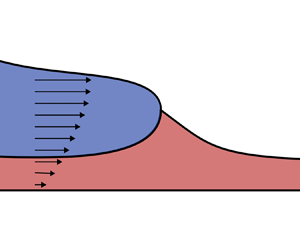
We examine the gravity-driven flow of a thin film of viscous fluid spreading over a rigid plate that is lubricated by another viscous fluid. We model the flow over such a ‘soft’ substrate by applying the principles of lubrication theory, assuming that vertical shear provides the dominant resistance to the flow. We do so in axisymmetric and two-dimensional geometries in settings in which the flow is self-similar. Different flow regimes arise, depending on the values of four key dimensionless parameters. As the viscosity ratio varies, the behaviour of the intruding layer ranges from that of a thin coating film, which exerts negligible traction on the underlying layer, to a very viscous gravity current spreading over a low-viscosity, near-rigid layer. As the density difference between the two layers approaches zero, the nose of the intruding layer steepens, approaching a shock front in the equal-density limit. We characterise a frontal stress singularity, which forms near the nose of the intruding layer, by performing an asymptotic analysis in a small neighbourhood of the front. We find from our asymptotic analysis that unlike single-layer viscous gravity currents, which exhibit a cube-root frontal singularity, the nose of a viscous gravity current propagating over another viscous fluid instead exhibits a square-root singularity, to leading order. We also find that large differences in the densities between the two fluids give rise to flows similar to that of thin films of a single viscous fluid spreading over a rigid, yet mobile, substrate.
Viewed from the perspective of public policy, behavioural public policy (BPP) faces challenges in four main areas: Systems, Impatience, Nudging, and Scaling. To address these challenges, several suggestions are proposed. First, understanding how BPP interventions unfold in complex systems requires better diagnostics and the development of predictive and generative models of human behaviour. Second, the rapid pace of policy processes necessitates a shift towards generating timely and fit-for-purpose evidence. Third, maximising the opportunities presented by BPP, beyond merely ‘nudging’, demands the early and proactive application of behavioural science in the policy cycle. Fourth, achieving widespread impact in BPP initiatives means considering scale-up from the start. Lastly, the consistent and comprehensive integration of behavioural science into standard policymaking practices would support sustainable progress in addressing these challenges.
The extent of de-novo biosynthesis of non-essential fatty acids (FA) and the endogenous biosynthesis of long chain PUFA in human fetuses remain largely unknown. We used natural variations in the 13C:12C (δ 13C) of plasma phospholipids of the woman at delivery and of cord blood to infer fetal biosynthesis of FA. We studied thirty-nine mother–fetus pairs with uncomplicated pregnancies and term delivery. Eighteen women were supplemented with DHA, from pregnancy week 20 until delivery, sourced from an algae (n 13) or fish oil (n 5), each with slightly different 13C content. Twenty-one women did not receive DHA supplementation. We measured the δ 13C value of selected phospholipid FA (C16:0, C18:0, C18:1n-9, C18:2n-6, C20:4n-6 and C22:6n-3) in maternal and cord plasma samples at delivery using isotope ratio MS. We found significant linear correlations for δ 13C values of FA between mothers and their fetuses (C16:0, r = 0·8535; C18:0, r = 0·9099; C18:1n-9, r = 0·8079; C18:2n-6, r = 0·9466; C20:4n-6, r = 0·9257 and C22:6n-3, r = 0·9706). Women supplemented with algal DHA had significantly lower DHA δ 13C values in their plasma phospholipids than those supplemented with fish DHA or those who did not receive DHA supplementation (P < 0·001). There was no significant difference in δ 13C values of FA between women at delivery and their fetuses. These findings strongly suggest that the human fetus is highly dependent on the placental transport of maternal plasma FA, particularly DHA. The limited fetal biosynthesis of major FA emphasises the crucial role of maternal nutrition and placental well-being in fetal development.
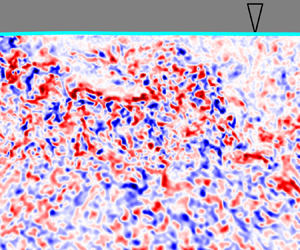
We investigate the turbulence below a quasi-flat free surface, focusing on the energy transport in space and across scales. We leverage a large zero-mean-flow tank where homogeneous turbulence is generated by randomly actuated jets. A wide range of Reynolds number is spanned, reaching sufficient scale separation for the emergence of an inertial sub-range. Unlike previous studies, the forcing extends through the source layer, although the surface deformation remains millimetric. Particle image velocimetry along a surface-normal plane resolves from the dissipative to the integral scales. The contributions to turbulent kinetic energy from both vertical and horizontal components of velocity approach the prediction based on rapid distortion theory as the Reynolds number is increased, indicating that discrepancies among previous studies are likely due to differences in the forcing. At odds with the theory, however, the integral scale of the horizontal fluctuations grows as the surface is approached. This is rooted in the profound influence exerted by the surface on the inter-scale energy transfer: along horizontal separations, the direct cascade of energy in horizontal fluctuations is hindered, while an inverse cascade of that in vertical fluctuations is established. This is connected to the structure of upwellings and downwellings. The former, characterized by somewhat larger spatial extent and stronger intensity, are associated with extensional surface-parallel motions. They thus transfer energy to the larger horizontal scales, prevailing over downwellings which favour the compression (and concurrent vertical stretching) of the eddies. Both types of structures extend to depths between the integral scale and the Taylor microscale.
Multi-site and multi-organizational teams are increasingly common in epidemiologic research; however, there is a lack of standards or best practices for achieving success in collaborative research networks in epidemiology. We summarize our experiences and lessons learned from the Diabetes Location, Environmental Attributes, and Disparities (LEAD) Network, a collaborative agreement between the Centers for Disease Control and Prevention and research teams at Drexel University, New York University, Johns Hopkins University and Geisinger, and the University of Alabama at Birmingham. We present a roadmap for success in collaborative epidemiologic research, with recommendations focused on the following areas to maximize efficiency and success in collaborative research agreements: 1) operational and administrative considerations; 2) data access and sharing of sensitive data; 3) aligning network research aims; 4) harmonization of methods and measures; and 5) dissemination of findings. Future collaborations can be informed by our experiences and ultimately dedicate more resources to achieving scientific aims and efficiently disseminating scientific work products.
The Cretaceous/Paleogene (K/Pg) mass extinction was a pivotal event in Earth history, the latest among five mass extinctions that devastated marine and terrestrial life. Whereas much research has focused on the global demise of dominant vertebrate groups, less is known about changes among plant communities during the K/Pg mass extinction. This study investigates a suite of 11 floral assemblages leading up to and across the K/Pg boundary in northeastern Montana constrained within a well-resolved chronostratigraphic framework. We evaluate the impact of the mass extinction on local plant communities as well as the timing of post-K/Pg recovery. Our results indicate that taxonomic composition changed significantly from the Late Cretaceous to Paleocene; we estimate that 63% of latest-Cretaceous plant taxa disappeared across the K/Pg boundary, on par with other records from North America. Overall, taxonomic richness dropped by ~23–33% from the Late Cretaceous to the Paleocene, a moderate decline compared with other plant records from this time. However, richness returned to Late Cretaceous levels within 900 kyr after the K/Pg boundary, significantly faster than observed elsewhere. We find no evidence that these results are due to preservational bias (i.e., differences in depositional environment) and instead interpret a dramatic effect of the K/Pg mass extinction on plant diversity and ecology. Overall, plant communities experienced major restructuring, that is, changes in relative abundance and unseating of dominant groups during the K/Pg mass extinction, even though no major (e.g., family-level) plant groups went extinct and communities in Montana quickly recovered in terms of taxonomic diversity. These results have direct bearing on our understanding of vegetation change during diversity crises, the differing responses of plant groups (e.g., angiosperms vs. gymnosperms), and spatial variation in extinction and recovery timing.
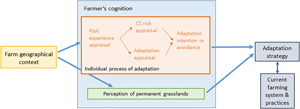
Climate change will increase average temperatures and the frequency and intensity of summertime droughts; those shifts will in turn affect forage production in grassland-based livestock farms. Farmers will accordingly likely have to implement adaptation strategies to cope with the effects of climate change. We hypothesized that farmers' resilience strategies would depend on (i) their intention to adapt to climate change, which partly results from previous climate risk exposure, (ii) how they perceive the values and disvalues of multi-species permanent grasslands (PGs), and (iii) that both of the aforementioned factors would vary according to the geographical context of each farm. We carried out 15 semi-structured interviews with dairy cattle farmers in the French Massif Central; the farms were distributed along a range of climatic and topographic conditions. We used (i) the Model of Proactive Private Adaptation to Climate Change to analyze farmers' individual process of adaptation, (ii) the Integrated Nature Futures Framework to analyze farmers' perception of multi-species PGs, and (iii) text analysis to identify the farmers' adaptation strategies. Nine of the farmers felt that they were already adapted to climate change or that they had a plan in place to implement new adaptations in the future. We observed straightforward relationships between these farmers' perception of PGs and their choice of adaptation strategy; those relationships varied, however, with the geographical context of each farm. Farmers in the northern Massif Central and southern uplands highlighted the values of PGs and considered PGs to be central to their adaption strategies. Conversely, farmers in the southern lowlands mostly referred to the disvalues of PGs; they based their adaptation strategies on temporary grasslands and forage crops. Three of the farmers believed that climate change posed a significant risk, but they foresaw little room to maneuver. Despite acknowledging the values of PGs, those individuals did not intend to use PGs to adapt to climate change. The final three farmers did not intend to adapt to climate change; their reasoning stemmed from either a mindset of fatalism or their acknowledged desire to retire soon. Extreme events such as the summertime drought of 2003 and human factors such as intergenerational transmission of farm can accordingly facilitate or inhibit climate change-related adaptation. It is accordingly important to take into account both socio-psychological and environmental factors when analyzing how grassland-based farmers transition to more climate change-resilient systems.
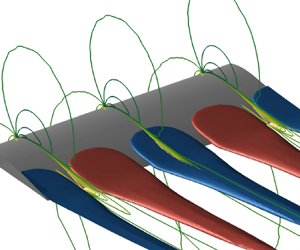
Stall cells are transverse cellular patterns that often appear on the suction side of airfoils near stalling conditions. Wind-tunnel experiments on a NACA4412 airfoil at Reynolds number ${Re}=3.5 \times 10^5$ show that they appear for angles of attack larger than $\alpha = 11.5^{\circ }\ (\pm 0.5^{\circ })$. Their onset is further investigated based on global stability analyses of turbulent mean flows computed with the Reynolds-averaged Navier–Stokes (RANS) equations. Using the classical Spalart–Allmaras turbulence model and following Plante et al. (J. Fluid Mech., vol. 908, 2021, A16), we first show that a three-dimensional stationary mode becomes unstable for a critical angle of attack $\alpha = 15.5^{\circ }$ which is much larger than in the experiments. A data-consistent RANS model is then proposed to reinvestigate the onset of these stall cells. Through an adjoint-based data-assimilation approach, several corrections in the turbulence model equation are identified to minimize the differences between assimilated and reference mean-velocity fields, the latter reference field being extracted from direct numerical simulations. Linear stability analysis around the assimilated mean flow obtained with the best correction is performed first using a perturbed eddy-viscosity approach which requires the linearization of both RANS and turbulence model equations. The three-dimensional stationary mode becomes unstable for angle $\alpha = 11^{\circ }$ which is in significantly better agreement with the experimental results. The interest of this perturbed eddy-viscosity approach is demonstrated by comparing with results of two frozen eddy-viscosity approaches that neglect the perturbation of the eddy viscosity. Both approaches predict the primary destabilization of a higher-wavenumber mode which is not experimentally observed. Uncertainties in the stability results are quantified through a sensitivity analysis of the stall cell mode's eigenvalue with respect to residual mean-flow velocity errors. The impact of the correction field on the results of stability analysis is finally assessed.


In recent years, an old contentious tactic in which protesters besiege and harass public officials in their private homes has resurged. Discontented sectors of all stripes have employed what is most commonly called charivari or “rough music.” To elucidate this surprising reappearance, this reflection highlights the rise of conflict over cultural and moral values, affective polarization, and the personalization of politics. Moreover, the proliferation of social media has eroded the boundary between the public and private sphere and thus propelled the resurgence of privacy-breaching direct action. This interpretive essay compares the special features of revived charivari with its earlier incarnations in premodern times and in the revolutions of the long nineteenth century, and with the internet harassment of the twenty-first century. By analyzing the reappearance of a contentious tactic with premodern roots, this essay seeks to shed light on broader trends of sociopolitical development in the postmodern age.
Empathy has been proposed as a solution to alleviate interparty antipathy. Recent findings from the US suggest that one aspect of empathy – empathic concern – increases rather than decreases affective polarization. Perspective-taking, another aspect of empathy, has no effect on affective polarization. In this article, we describe a preregistered replication and extension of these findings in the contrasting political context of the Netherlands, to see whether this relationship generalizes beyond the US. First, using a cross-sectional nationally representative sample of 1,258 Dutch voters, we show that empathic concern indeed fuels affective polarization while at the same time we find that perspective-taking reduces it. Second, using a two-arm survey experiment (n = 438), we show that perspective-taking reduces ingroup bias, whereas empathic concern does not. Reflecting on the American and Dutch findings, we conclude that while empathic concern likely contributes to affective polarization, perspective-taking may reduce it.
Both childhood adversity (CA) and first-episode psychosis (FEP) have been linked to alterations in cortical thickness (CT). The interactive effects between different types of CAs and FEP on CT remain understudied.
Methods
One-hundred sixteen individuals with FEP (mean age = 23.8 ± 6.9 years, 34% females, 80.2% non-affective FEP) and 98 healthy controls (HCs) (mean age = 24.4 ± 6.2 years, 43% females) reported the presence/absence of CA <17 years using an adapted version of the Childhood Experience of Care and Abuse (CECA.Q) and the Retrospective Bullying Questionnaire (RBQ) and underwent magnetic resonance imaging (MRI) scans. Correlation analyses were used to assess associations between brain maps of CA and FEP effects. General linear models (GLMs) were performed to assess the interaction effects of CA and FEP on CT.
Results
Eighty-three individuals with FEP and 83 HCs reported exposure to at least one CA. CT alterations in FEP were similar to those found in participants exposed to separation from parents, bullying, parental discord, household poverty, and sexual abuse (r = 0.50 to 0.25). Exposure to neglect (β = −0.24, 95% CI [−0.37 to −0.12], p = 0.016) and overall maltreatment (β = −0.13, 95% CI [−0.20 to −0.06], p = 0.043) were associated with cortical thinning in the right medial orbitofrontal region.
Conclusions
Cortical alterations in individuals with FEP are similar to those observed in the context of socio-environmental adversity. Neglect and maltreatment may contribute to CT reductions in FEP. Our findings provide new insights into the specific neurobiological effects of CA in early psychosis.
Fiber Bragg grating-based Raman oscillators are capable of achieving targeted frequency conversion and brightness enhancement through the provision of gain via stimulated Raman scattering across a broad gain spectrum. This capability renders them an exemplary solution for the acquisition of high-brightness, specialized-wavelength lasers. Nonetheless, the output power of all-fiber Raman oscillators is typically limited to several hundred watts, primarily due to limitations in injectable pump power and the influence of higher-order Raman effects, which is inadequate for certain application demands. In this study, we introduce an innovative approach by employing a graded-index fiber with a core diameter of up to 150 μm as the Raman gain medium. This strategy not only enhances the injectable pump power but also mitigates higher-order Raman effects. Consequently, we have successfully attained an output power of 1780 W for the all-fiber Raman laser at 1130 nm, representing the highest output power in Raman fiber oscillators with any configuration reported to date.
Much has changed since 2007–2010 when I co-edited the journal Politics & Gender (P&G) with Kathleen Dolan. In this essay, I reflect on the changes in the journal and the subfield of a comparative politics of gender. Dolan and I were the second team to edit the journal, following in the footsteps of the inaugural editors Karen Beckwith and Lisa Baldez. The journal was finding its footing at the time, and increasing submissions was a key concern. This year, on its 20th anniversary, we can celebrate that the journal, like the subfield of gender and politics, has flourished and matured. The number of articles published by the journal has multiplied exponentially and the quality of articles has improved significantly. Moreover, the journal has demonstrably helped shape the subfield of a comparative politics of gender in ways that I outline below.