Statistical Modeling and Inference for Social Science
, University of California, Berkeley
Online ISBN: 9781139047449
Online publication date:
28 May 2018
Hardback ISBN: 9781107003149
Hardback publication date: 09 June 2014
Paperback ISBN: 9781316622223
Paperback publication date: 06 April 2017
- Textbook
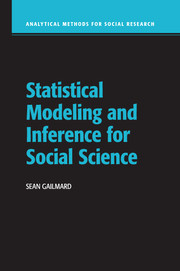
Written specifically for graduate students and practitioners beginning social science research, Statistical Modeling and Inference for Social Science covers the essential statistical tools, models and theories that make up the social scientist's toolkit. Assuming no prior knowledge of statistics, this textbook introduces students to probability theory, statistical inference and statistical modeling, and emphasizes the connection between statistical procedures and social science theory. Sean Gailmard develops core statistical theory as a set of tools to model and assess relationships between variables - the primary aim of social scientists - and demonstrates the ways in which social scientists express and test substantive theoretical arguments in various models. Chapter exercises guide students in applying concepts to data, extending their grasp of core theoretical concepts. Students will also gain the ability to create, read and critique statistical applications in their fields of interest.
Written specifically for graduate students and practitioners beginning social science research, Statistical Modeling and Inference for Social Science covers the essential statistical tools, models and theories that make up the social scientist's toolkit. Assuming no prior knowledge of statistics, this textbook introduces students to probability theory, statistical inference and statistical modeling, and emphasizes the connection between statistical procedures and social science theory. Sean Gailmard develops core statistical theory as a set of tools to model and assess relationships between variables - the primary aim of social scientists - and demonstrates the ways in which social scientists express and test substantive theoretical arguments in various models. Chapter exercises guide students in applying concepts to data, extending their grasp of core theoretical concepts. Students will also gain the ability to create, read and critique statistical applications in their fields of interest.