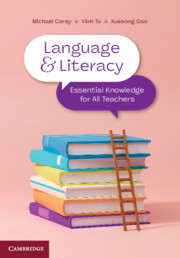
Language and Literacy
Essential Knowledge for All Teachers
, University of the Sunshine Coast, Queensland, , University of Tasmania, , University of New South Wales, Sydney
Online ISBN: 9781009366144
Online publication date:
29 May 2025
Paperback ISBN: 9781009366175
Paperback publication date: 12 June 2025
- Textbook
Literacy is important foundational knowledge for all teaching areas and classroom settings. Language and Literacy covers the building blocks of literacy, as well as the developmental skills all pre-service and in-service teachers need to teach effectively and meaningfully across the Australian curriculum. Part one moves chronologically from the early years to the secondary years, covering phonological, phonemic and morphological awareness, word and sentence-level grammar, language use in social contexts, and a discussion on English language diversity and change. Part two introduces the metalanguage, content knowledge and teaching methods required to develop students' competence in vocabulary, text types and grammar, as well as oracy, reading, writing and critical literacy. Each chapter includes discussion points and further resources to engage students, with key terms linked to the comprehensive glossary. Written by experienced educators, Language and Literacy is an essential resource, offering a focused exploration of language and literacy knowledge for pre-service and in-service teachers.
Literacy is important foundational knowledge for all teaching areas and classroom settings. Language and Literacy covers the building blocks of literacy, as well as the developmental skills all pre-service and in-service teachers need to teach effectively and meaningfully across the Australian curriculum. Part one moves chronologically from the early years to the secondary years, covering phonological, phonemic and morphological awareness, word and sentence-level grammar, language use in social contexts, and a discussion on English language diversity and change. Part two introduces the metalanguage, content knowledge and teaching methods required to develop students' competence in vocabulary, text types and grammar, as well as oracy, reading, writing and critical literacy. Each chapter includes discussion points and further resources to engage students, with key terms linked to the comprehensive glossary. Written by experienced educators, Language and Literacy is an essential resource, offering a focused exploration of language and literacy knowledge for pre-service and in-service teachers.