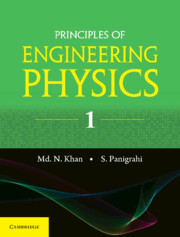
Principles of Engineering Physics 1
, Indira Gandhi Institute of Technology (IGIT), Odisha, , Indian Institute of Technology, Delhi
Online ISBN: 9781316876947
Online publication date:
06 August 2018
Paperback ISBN: 9781316635643
Paperback publication date: 06 March 2017
- Textbook
Covers the basic principles and theories of engineering physics and offers a balance between theoretical concepts and their applications. It is designed as a textbook for an introductory course in engineering physics. Beginning with a comprehensive discussion on oscillations and waves with applications in the field of mechanical and electrical engineering, it goes on to explain the basic concepts such as Huygen's principle, Fresnel's biprism, Fraunhofer diffraction and polarization. Emphasis has been given to an understanding of the basic concepts and their applications to a number of engineering problems. Each topic has been discussed in detail, both conceptually and mathematically. Pedagogical features including solved problems, unsolved exercised and multiple choice questions are interspersed throughout the book. This will help undergraduate students of engineering acquire skills for solving difficult problems in quantum mechanics, electromagnetism, nanoscience, energy systems and other engineering disciplines.
Covers the basic principles and theories of engineering physics and offers a balance between theoretical concepts and their applications. It is designed as a textbook for an introductory course in engineering physics. Beginning with a comprehensive discussion on oscillations and waves with applications in the field of mechanical and electrical engineering, it goes on to explain the basic concepts such as Huygen's principle, Fresnel's biprism, Fraunhofer diffraction and polarization. Emphasis has been given to an understanding of the basic concepts and their applications to a number of engineering problems. Each topic has been discussed in detail, both conceptually and mathematically. Pedagogical features including solved problems, unsolved exercised and multiple choice questions are interspersed throughout the book. This will help undergraduate students of engineering acquire skills for solving difficult problems in quantum mechanics, electromagnetism, nanoscience, energy systems and other engineering disciplines.