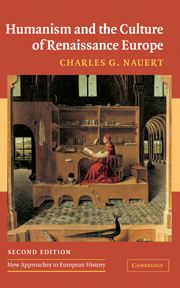
Humanism and the Culture of Renaissance Europe
2nd edition
, University of Missouri, Columbia
Online ISBN: 9780511808388
Online publication date:
28 May 2018
Hardback ISBN: 9780521839099
Hardback publication date: 29 May 2006
Paperback ISBN: 9780521547819
Paperback publication date: 29 May 2006
- Textbook
In this updated edition of his classic account, Charles Nauert charts the rise of humanism as the distinctive culture of the social, political and intellectual elites in Renaissance Europe. He traces humanism's emergence in the unique social and cultural conditions of fourteenth-century Italy and its gradual diffusion throughout the rest of Europe. He shows how, despite its elitist origins, humanism became a major force in the popular culture and fine arts of the fifteenth and sixteenth centuries, and the powerful impact it had on both the Protestant and Catholic Reformations. He uses art and biographical sketches of key figures to illuminate the narrative and concludes with an account of the limitations of humanism at the end of the Renaissance. The revised edition includes a section dealing with the place of women in humanistic culture and an updated bibliography. It will be essential reading for all students of Renaissance Europe.
In this updated edition of his classic account, Charles Nauert charts the rise of humanism as the distinctive culture of the social, political and intellectual elites in Renaissance Europe. He traces humanism's emergence in the unique social and cultural conditions of fourteenth-century Italy and its gradual diffusion throughout the rest of Europe. He shows how, despite its elitist origins, humanism became a major force in the popular culture and fine arts of the fifteenth and sixteenth centuries, and the powerful impact it had on both the Protestant and Catholic Reformations. He uses art and biographical sketches of key figures to illuminate the narrative and concludes with an account of the limitations of humanism at the end of the Renaissance. The revised edition includes a section dealing with the place of women in humanistic culture and an updated bibliography. It will be essential reading for all students of Renaissance Europe.