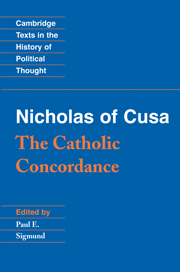
Nicholas of Cusa: The Catholic Concordance
Edited and translated by , Princeton University, New Jersey
Online ISBN: 9780511811999
Online publication date:
28 May 2018
Hardback ISBN: 9780521402071
Hardback publication date: 31 January 1992
Paperback ISBN: 9780521567732
Paperback publication date: 23 February 1996
Now available in paperback, this is the first English translation of the most important work of political thought of the fifteenth century. The Catholic Concordance is the first major treatise to argue for consent through representative councils as a major prerequisite for legitimate law and government, and is the most learned and original work associated with the conciliar movement in the late medieval church. Cusa's arguments influenced such thinkers as Luther, Bruno and Locke, and Professor Sigmund's introduction places his work in its full historical and philosophical context. The volume contains all the standard series features including a chronology, note on sources and bibliography, and as one of the earliest formulations of the view that political legitimacy rests on consent, The Catholic Concordance will be of interest to a wide range of scholars and students of the history of European ideas.
Now available in paperback, this is the first English translation of the most important work of political thought of the fifteenth century. The Catholic Concordance is the first major treatise to argue for consent through representative councils as a major prerequisite for legitimate law and government, and is the most learned and original work associated with the conciliar movement in the late medieval church. Cusa's arguments influenced such thinkers as Luther, Bruno and Locke, and Professor Sigmund's introduction places his work in its full historical and philosophical context. The volume contains all the standard series features including a chronology, note on sources and bibliography, and as one of the earliest formulations of the view that political legitimacy rests on consent, The Catholic Concordance will be of interest to a wide range of scholars and students of the history of European ideas.