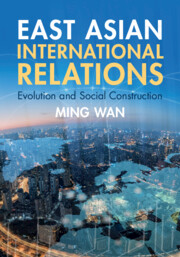
East Asian International Relations
Evolution and Social Construction
, George Mason University, Virginia
Online ISBN: 9781009364607
Online publication date:
28 November 2024
Paperback ISBN: 9781009364591
Paperback publication date: 20 February 2025
Hardback ISBN: 9781009364577
Hardback publication date: 20 February 2025
- Textbook
Through the outline of a coherent theoretical foundation for understanding East Asian international relations, this textbook offers a fresh, analytical approach, including applications of evolutionary theory that differ from and contextualize the prevailing theories currently offered for studies of East Asia. It provides an extensive coverage of ancient world order and European imperialism preceding contemporary themes of security, economic development, money and finance, regionalism, the US-China rivalry, and democracy versus autocracy. Demonstrating systemically how facts and theories are constructed, and how these are bound by evolutionary constraints, students gain a realistic view of knowledge production and the mindset and tools to participate actively in determining which facts and theories are more acceptable than alternatives. Feature boxes, discussion questions, exercises, and recommended readings are incorporated into each chapter to encourage active learning. A vital new resource for advanced undergraduate and graduate students in political science, international relations, and Asian studies.
Through the outline of a coherent theoretical foundation for understanding East Asian international relations, this textbook offers a fresh, analytical approach, including applications of evolutionary theory that differ from and contextualize the prevailing theories currently offered for studies of East Asia. It provides an extensive coverage of ancient world order and European imperialism preceding contemporary themes of security, economic development, money and finance, regionalism, the US-China rivalry, and democracy versus autocracy. Demonstrating systemically how facts and theories are constructed, and how these are bound by evolutionary constraints, students gain a realistic view of knowledge production and the mindset and tools to participate actively in determining which facts and theories are more acceptable than alternatives. Feature boxes, discussion questions, exercises, and recommended readings are incorporated into each chapter to encourage active learning. A vital new resource for advanced undergraduate and graduate students in political science, international relations, and Asian studies.