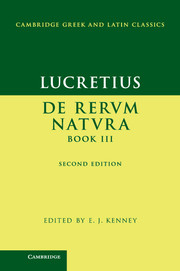
Lucretius: De Rerum NaturaBook III
2nd edition
Edited by , University of Cambridge
Online ISBN: 9780511843754
Online publication date:
12 September 2018
Hardback ISBN: 9781107002111
Hardback publication date: 29 September 2014
Paperback ISBN: 9780521173896
Paperback publication date: 29 September 2014
- Textbook
The third book of Lucretius' great poem on the workings of the universe is devoted entirely to expounding the implications of Epicurus' dictum that death does not matter, 'is nothing to us'. The soul is not immortal: it no more exists after the dissolution of the body than it had done before its birth. Only if this fact is accepted can men rid themselves of irrational fears and achieve the state of ataraxia, freedom from mental disturbance, on which the Epicurean definition of pleasure was based. To present this case Lucretius deploys the full range of poetic and rhetorical registers, soberly prohibitive, artfully decorative or passionately emotive as best suits his argument, reinforcing it with vivid and compelling imagery. This new edition has been completely revised, with a considerably enlarged Commentary and a new supplementary introduction taking account of the great amount of new scholarship of the last forty years.
The third book of Lucretius' great poem on the workings of the universe is devoted entirely to expounding the implications of Epicurus' dictum that death does not matter, 'is nothing to us'. The soul is not immortal: it no more exists after the dissolution of the body than it had done before its birth. Only if this fact is accepted can men rid themselves of irrational fears and achieve the state of ataraxia, freedom from mental disturbance, on which the Epicurean definition of pleasure was based. To present this case Lucretius deploys the full range of poetic and rhetorical registers, soberly prohibitive, artfully decorative or passionately emotive as best suits his argument, reinforcing it with vivid and compelling imagery. This new edition has been completely revised, with a considerably enlarged Commentary and a new supplementary introduction taking account of the great amount of new scholarship of the last forty years.