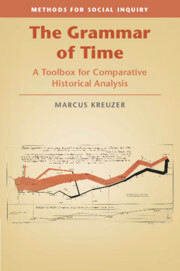
The Grammar of Time
A Toolbox for Comparative Historical Analysis
, Villanova University, Pennsylvania
Online ISBN: 9781108652728
Online publication date:
11 May 2023
Hardback ISBN: 9781108483780
Hardback publication date: 25 May 2023
Paperback ISBN: 9781108718233
Paperback publication date: 25 May 2023
Kreuzer offers guidance to scholars looking to comparative historical analysis (CHA) for the tools to analyze macro-historical questions. Like history, CHA uses the past to formulate research questions, describe social transformations, and generate inductive insights. Like social science, CHA compares those patterns to explicate generalizable and testable theories. It operates in two different worlds—one constantly changing and full of cultural particularities and another static and full of orderly uniformities. CHA draws attention to the ontological constructions of these worlds; how scholars background historical and geographic particularities to create a social reality orderly enough for theorizing, while others foreground those particularities to re-complexify it to generate new inductive insights. CHA engages in ontological triage, dialogue between exploration and confirmation, and conversation in how to translate test results into genuine answers. This book is supplemented by online materials including introductory videos, diagnostic quizzes, advanced exercises, and annotated bibliographies.
Kreuzer offers guidance to scholars looking to comparative historical analysis (CHA) for the tools to analyze macro-historical questions. Like history, CHA uses the past to formulate research questions, describe social transformations, and generate inductive insights. Like social science, CHA compares those patterns to explicate generalizable and testable theories. It operates in two different worlds—one constantly changing and full of cultural particularities and another static and full of orderly uniformities. CHA draws attention to the ontological constructions of these worlds; how scholars background historical and geographic particularities to create a social reality orderly enough for theorizing, while others foreground those particularities to re-complexify it to generate new inductive insights. CHA engages in ontological triage, dialogue between exploration and confirmation, and conversation in how to translate test results into genuine answers. This book is supplemented by online materials including introductory videos, diagnostic quizzes, advanced exercises, and annotated bibliographies.